
If you want to track Perplexity and understand how AI search engines surface brands, you’re already ahead of the curve. Google no longer owns discovery, and AI platforms like Perplexity are becoming major entry points for research, recommendations, and buying decisions, often citing only one or two sources per answer.
If Perplexity isn’t mentioning your brand, you’re invisible in a fast-growing search channel.
This guide shows you:
-
How to track brand mentions in Perplexity.
-
How Perplexity chooses sources.
-
Why AI search visibility matters.
-
How to increase citations using AEO (Answer Engine Optimization).
-
How to use Keyword.com’s Perplexity Visibility Tracker to measure rankings and sentiment.
How to Track Your Brand Mentions in Perplexity Results
AI search doesn’t use traditional rankings, impressions, or Search Console data, so you need an AI visibility tracker to see when Perplexity cites your brand. Keyword.com, Peec.ai, Advanced Web Ranking, and other AI rank trackers can help you monitor your brand mentions in Perplexity search results.
Here’s how to track Perplexity rankings using Keyword.com:
Step 1: Sign up for Keyword.com’s AI Visibility Tracker

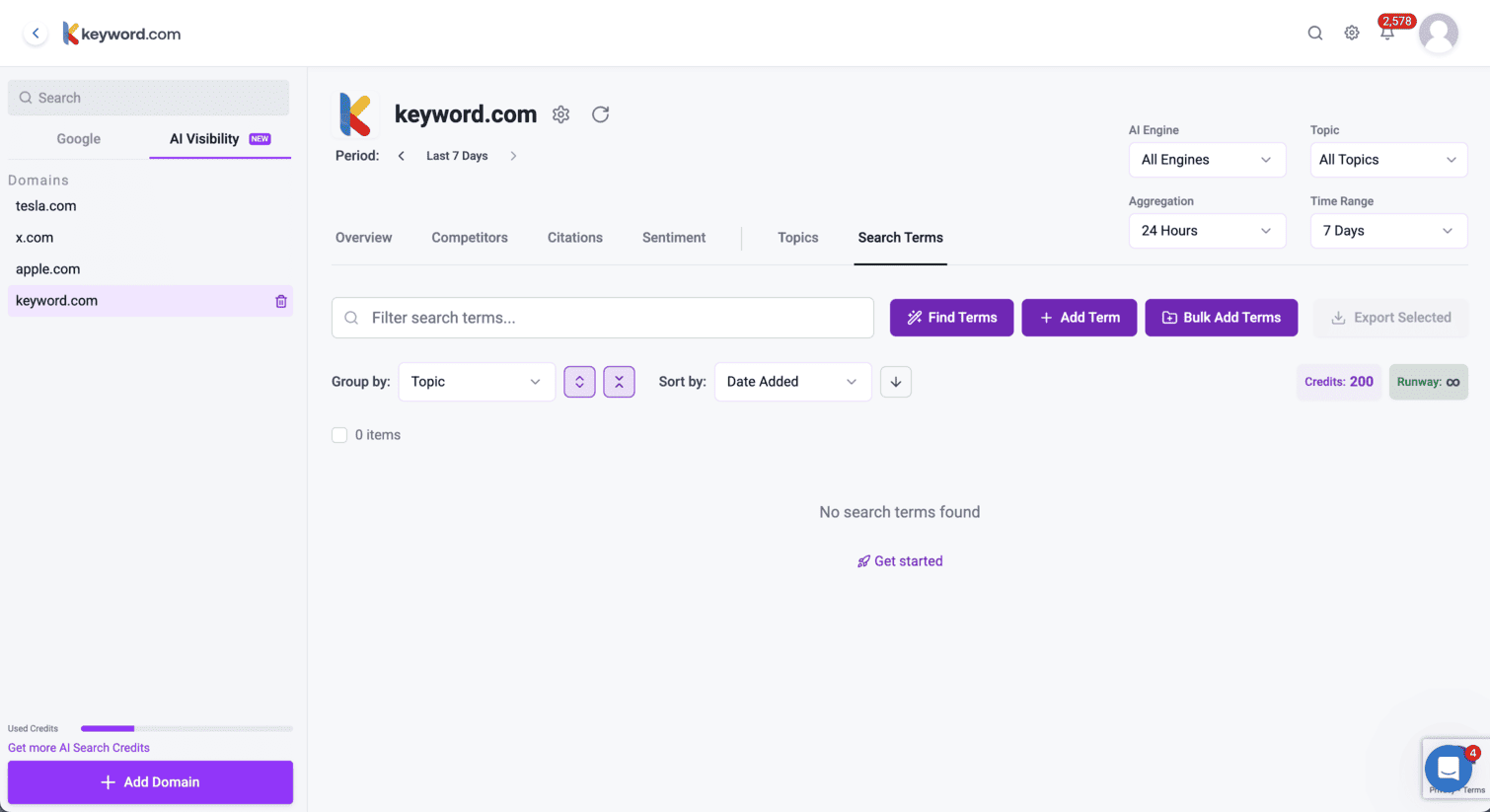
Step 2: Add Your Website and Select the Keywords or Prompts You Want to Track
Not sure what to add? Use Find Term to pull relevant queries automatically.
Step 3: Select Which Perplexity Model to Track
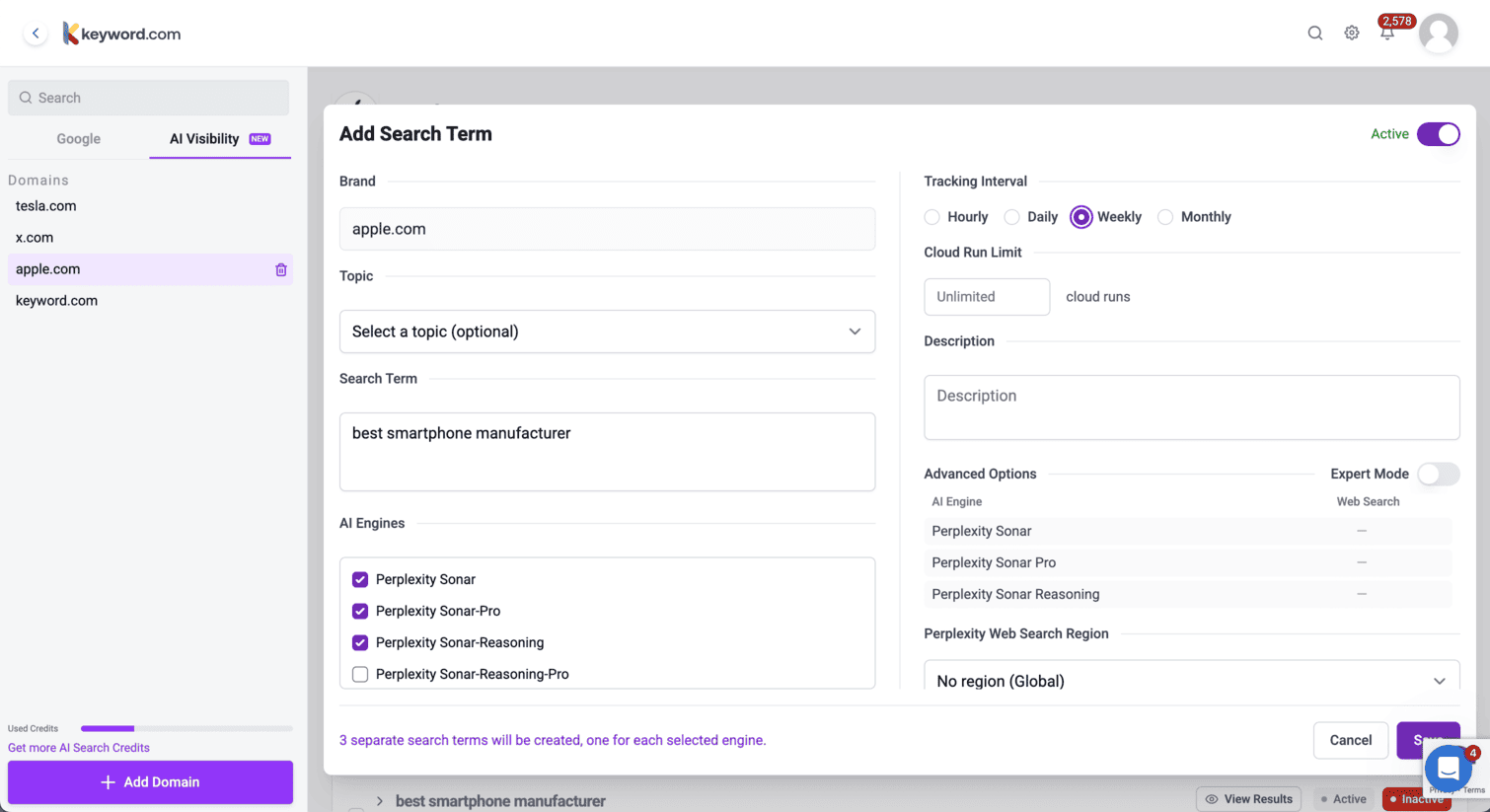
Keyword.com supports four models: Perplexity Sonar, Sonar-Pro, Sonar-Reasoning, and Sonar-Reasoning Pro.
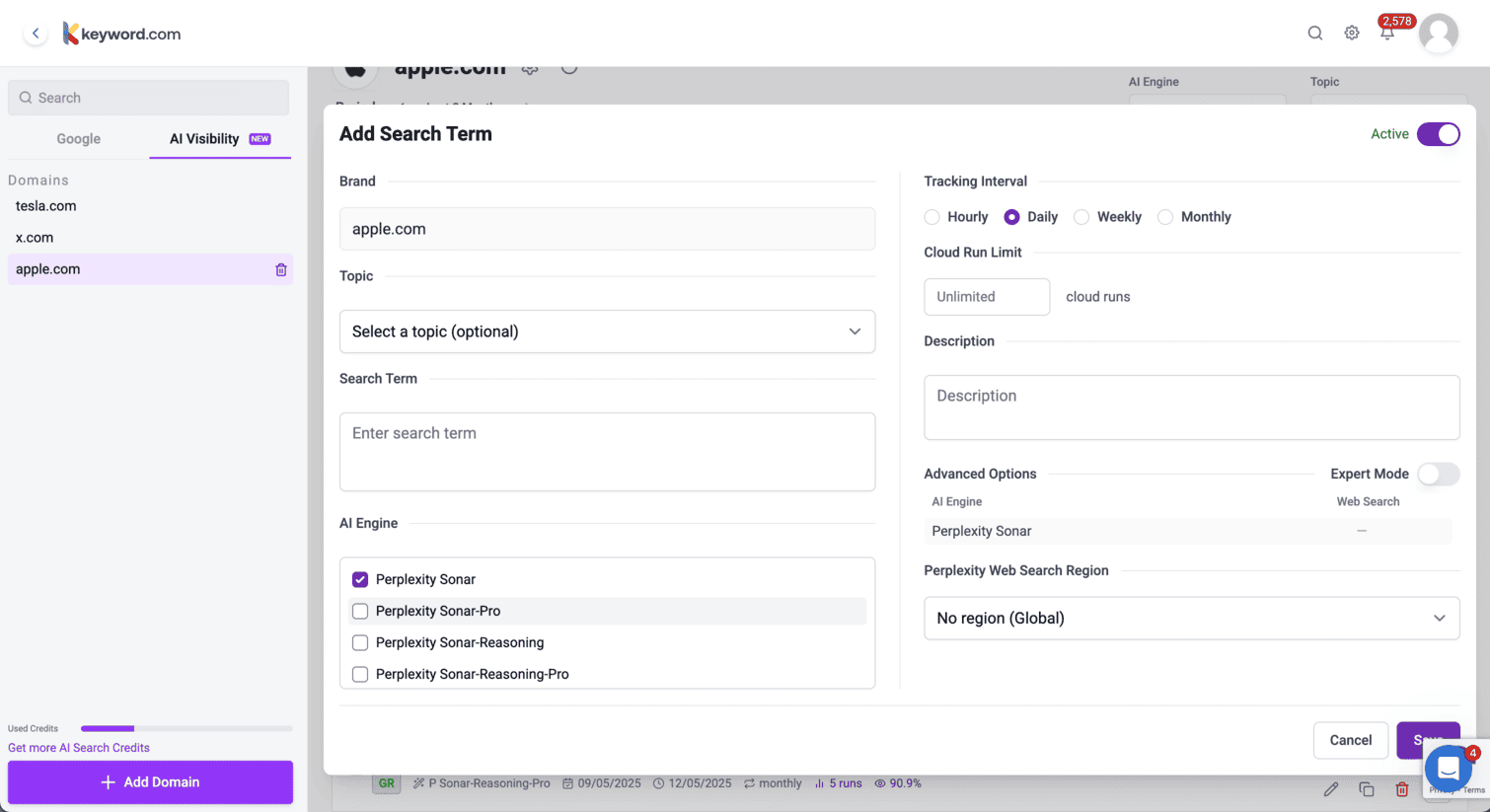
Step 4: Choose How Often You Want to Monitor Results
You can choose hourly, daily, weekly, or monthly AI brand monitoring. Then click “Save.”
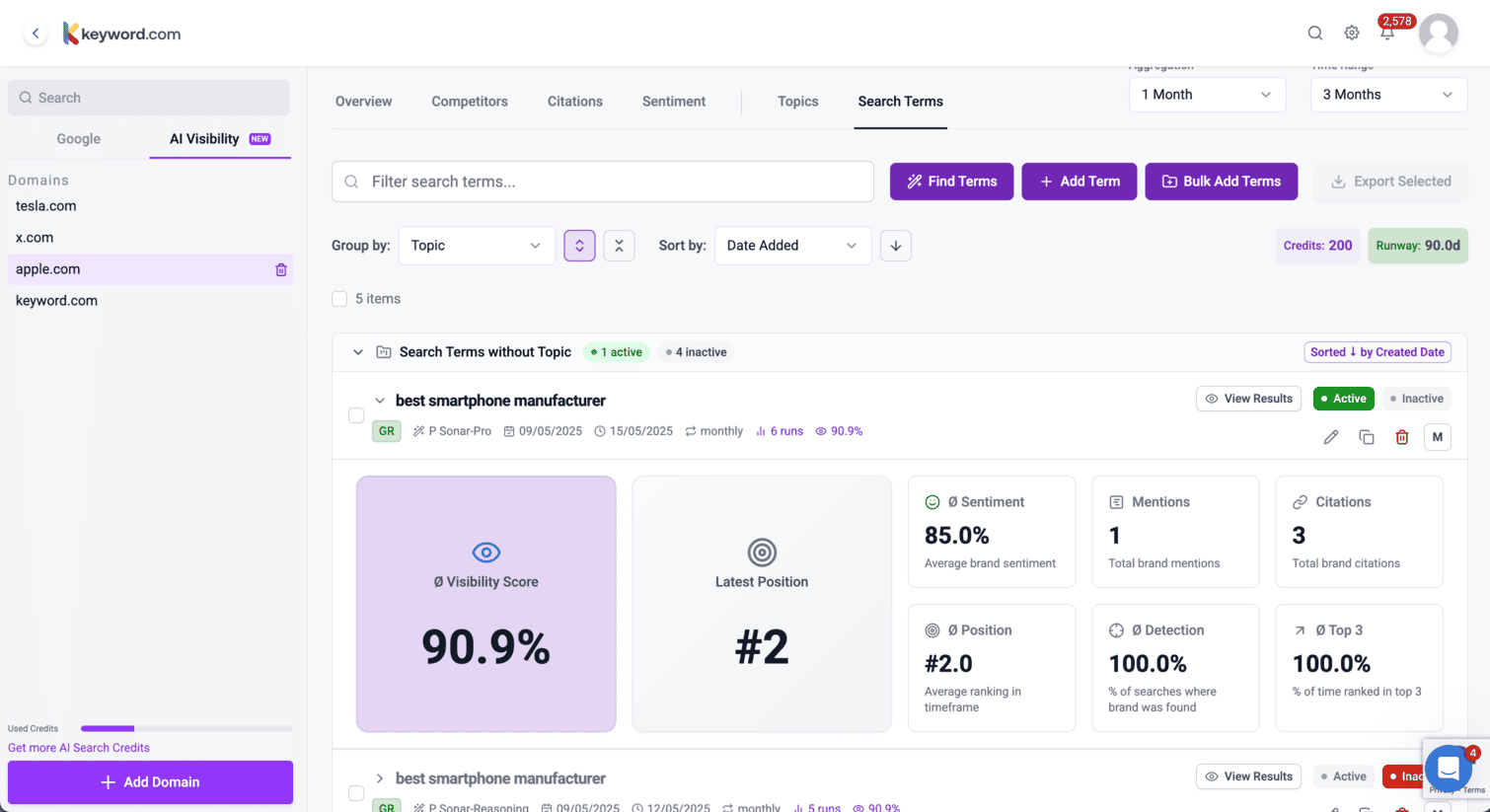
Once this is all set, you should see a personalized AI brand monitoring dashboard that looks like this.
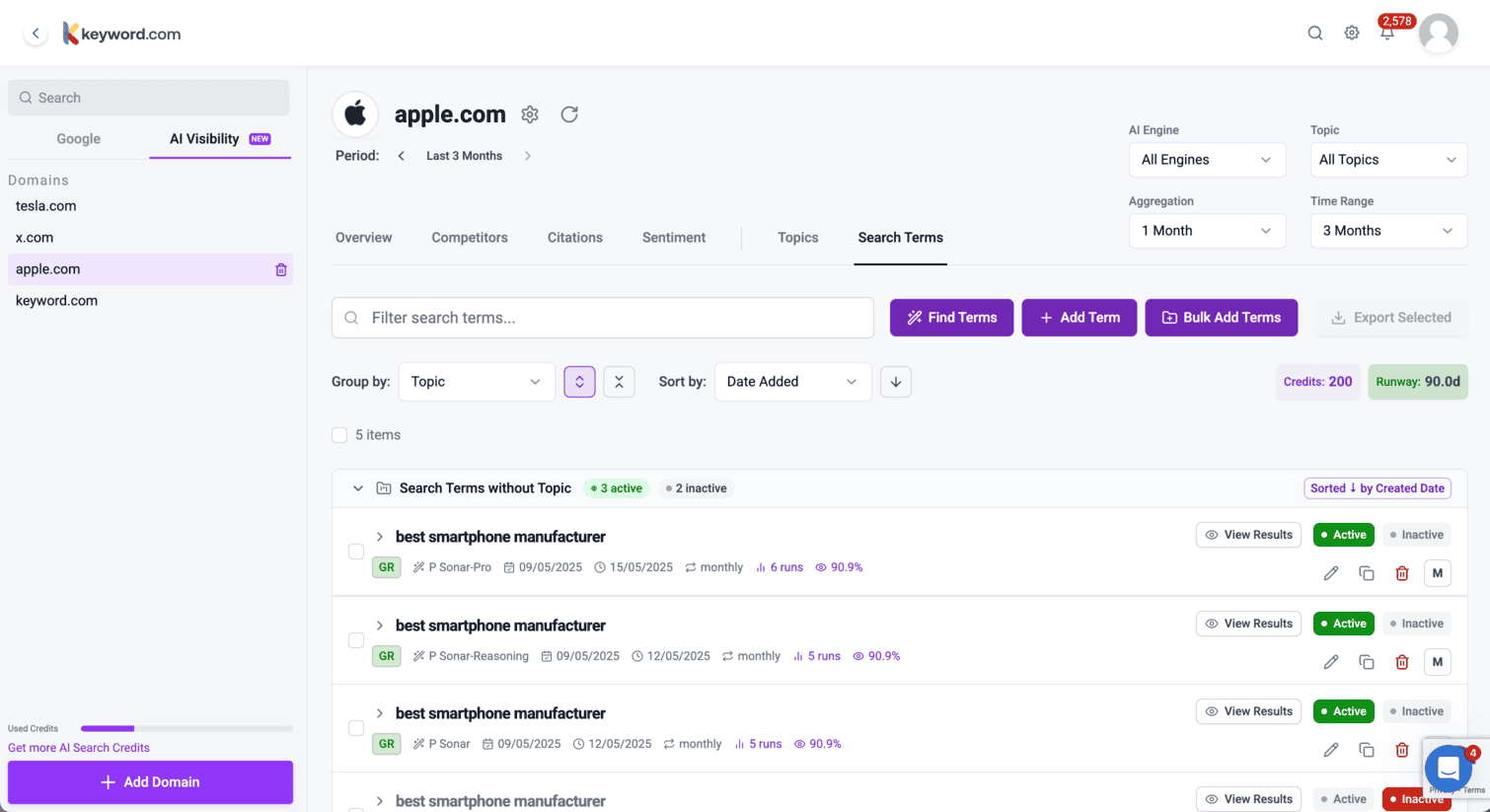
Here, you’ll find a detailed breakdown of your visibility for each tracked term, including your AI visibility score, sentiment score, and average Perplexity ranking over time.
Step 5: View Your AI Visibility Dashboard
Click on “View Results” to get more granular data about your brand’s performance in Perplexity AI, including:
- Your ranking history for tracking AI visibility changes over time.
- Mention brand analysis to help you monitor your competitors’ visibility for important search terms.
- Citation data that shows the exact website(s) Perplexity is retrieving information from for its answers.
Related: Simple Perplexity AI tracking tutorial
Why Perplexity AI Matters for Brand Visibility
Perplexity has grown massively:
Users treat Perplexity like a trusted research assistant, and its answers often include just one cited source. That source could be you, or it could be your competitor.

Here’s why tracking Perplexity matters:
1. It’s a Fast-Growing Search Channel
People now ask Perplexity:
-
“best tools for…”
-
“how to…”
-
“[brand] vs [brand].”
-
“top alternatives to…”
If your brand never appears in these lists, you’re missing critical discovery moments.
2. AI Search is Replacing Traditional SEO Clicks
Google’s zero-click rate is nearly 60%, and rising. Perplexity, ChatGPT, Gemini, and Claude all reduce link clicks even further by giving direct answers. If AI summaries cite someone else, your organic traffic drops, even if your Google rankings haven’t changed.
3. You Can Diagnose AI-Related Traffic Drops
Was there a sudden organic decline?
Tracking Perplexity answers helps you see whether:
-
Perplexity now cites a competitor.
-
Your previously cited pages dropped.
-
Your content is outdated or less authoritative.
-
AI Overviews / AI search engines are cannibalizing your queries.
4. Competitive Advantage
If Competitor A is being cited for “best [product] for X,” and you’re not, that competitor is capturing:
-
trust
-
mindshare
-
conversions
AI search amplifies winners and hides everyone else.
What Perplexity AI is, and How It Chooses Sources
Perplexity is an AI search engine that:
-
Answers queries in natural language.
-
Pulls real-time web sources.
-
Generates synthesized explanations.
-
Includes citations for every claim.
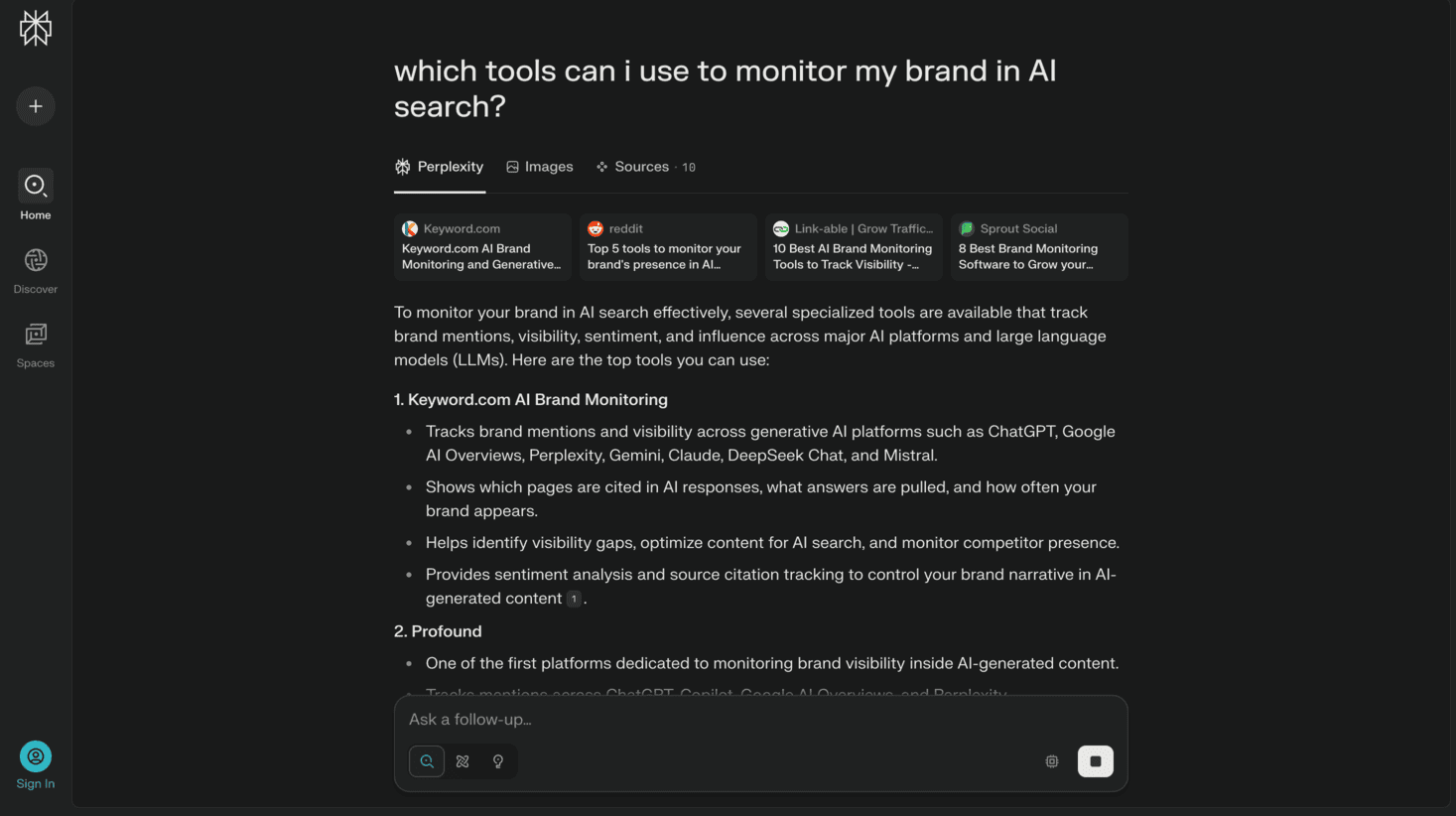
Unlike ChatGPT, Perplexity always conducts live searches, which means that fresh content, authority, clarity, structure, and source trustworthiness matter.
Its source selection is influenced by:
-
Topical authority.
-
Clarity of structure (Q&A, definitions, schema).
-
Update frequency.
-
Domain trust signals.
-
How directly your content answers the query.
Perplexity isn’t ranking URLs like Google. It’s choosing which pages deserve to be cited in its answer. This is a different optimization game and a different tracking game.
Want to learn more about how Perplexity handles search queries? This video breaks it down.

How to Increase Your Brand Mentions in Perplexity Answers
Tracking your brand in Perplexity is only the first step. The real value comes from using that data to evolve your search strategy and increase how often your brand is cited.
Apply these answer engine optimization (AEO) tactics to make Perplexity reference your content more often:
1. Audit Where You’re Missing
Use your tracking data to identify keywords, topics, or question types where Perplexity answers your audience’s queries, but doesn’t mention your brand. These are gaps in your topical authority.
For example, if you offer SEO audits, but Perplexity cites competitors for “how to run a technical SEO audit,” you’ve found a content gap.
- Look at queries where your competitors are mentioned, but you’re not.
- Categorize those queries by topic, intent (informational, commercial), and customer journey stage (this guide from Nextiva breaks it down clearly).
- Identify patterns: are you missing in early-stage research queries? Technical questions? Product comparisons?
Prioritize these types of content in your SEO strategy for better topic coverage.
2. Answer Specific Questions with Your Content
Perplexity favors content that directly answers questions in a clear, structured way. Long, unfocused blog posts are less likely to be quoted than concise, well-organized content that matches how people ask questions.
Make it easy for Perplexity AI to parse your content and lift a direct quote that fully answers the user’s question.
- Use headings that mirror how people ask questions (e.g., “How does local SEO work?”). Include “What is…”, “How to…”, and “Why does…” subheadings to answer common questions quickly.
- Write lead paragraphs that summarize the answer clearly.
- Use schema markup (like FAQ or HowTo) to increase parseability.
- Add bullet points, bolded takeaways, and concise summaries.
3. Build Topical Authority, Not Just Keyword Coverage
Perplexity pulls answers from sources that are seen as authoritative across an entire topic, not just one article. That means publishing one solid blog post isn’t enough. You need depth and consistency around the core themes and topics in your industry.
The more consistently you show expertise across related queries, the more likely Perplexity’s model will consider you a reliable source and cite you accordingly.
- Create content clusters: Publish multiple articles around related subtopics and interlink them.
- Cover both beginner and advanced angles of your field.
- Regularly update and expand cornerstone pieces.
- Prioritize clarity, structure, and educational value over SEO keyword stuffing.
4. Improve Your Site’s Trust and Quality Signals
Perplexity’s ability to choose sources is influenced by what it deems trustworthy: clean structure, source transparency, update frequency, and technical site quality all matter.
To increase your chances of ranking in Perplexity AI, add trust signals to your content and website:
- Add clear bylines with author bios (especially if they have subject-matter expertise).
- Use HTTPS and a fast, mobile-optimized layout.
- Display the article’s publish and update dates to signal content freshness.
- Include links to supporting research or industry sources.
Also, invest in building your brand’s credibility through backlinks, mentions, and social shares. High-quality backlinks and engagement signals act as indirect trust indicators, making your content more likely to be cited in AI-generated answers.
5. Monitor and Analyze Competitor Mentions
If a competitor keeps getting cited in your space, it’s not by luck. They’re doing something structurally right with how they create content, how they promote it, or how often they publish.
Read: Answer Engine Optimization Strategies: What Top Brands Do to Keep Getting Cited
Track Your Perplexity Rankings with Keyword.com
Keyword.com’s AI Visibility Tracker is the most accurate way to monitor your brand mentions in Perplexity AI results. Beyond showing you where you rank, our AI brand monitoring tool provides granular insights like citations, ranking history, and competitor tracking, giving you a holistic view of your AI search performance.
Sign up for a free trial and start tracking your Perplexity rankings today.
Perplexity AI Tracking FAQs
Got more questions about tracking your brand mentions in Perplexity AI? You’ll find some helpful answers below.
1. How Do I Get My Brand Mentioned in Perplexity AI Answers?
To appear in Perplexity answers, your content must be authoritative, structured, and easy for AI to parse.
Focus on:
-
Clear Q&A formatting.
-
Direct, concise explanations.
-
Fresh, regularly updated content.
-
Strong topical depth across related subjects.
-
Schema markup (FAQ, HowTo, Product).
Perplexity cites sources that feel reliable, well-structured, and factually clear, not just the highest-ranking pages.
2. Which Tool Tracks Brand Mentions in Perplexity AI?
You can use Keyword.com’s AI Visibility Tracker to monitor if and how your brand is mentioned in Perplexity AI answers. Our AI brand monitoring tool shows you:
- Where your brand appears in AI-generated results
- Which keywords trigger those mentions
- How your brand is framed (positively, negatively, or neutrally)
- What sources are being cited instead of you
3. How Do I Track Brand Visibility Across All AI Search Engines (Perplexity, ChatGPT, Gemini, Claude)?
Generative engines don’t produce SERPs, so traditional rank trackers cannot measure AI visibility. Use Keyword.com’s AI Rank Tracker to monitor:
-
Mentions across Perplexity, AI Overviews, ChatGPT, Gemini, and Claude.
-
Changes in AI visibility scores.
-
Competitor citations.
-
Sentiment over time.
-
Prompt-level inclusion.
4. What Triggers a Brand Mention in Perplexity?
Perplexity chooses sources based on:
-
Authority (trust signals, backlinks, citations).
-
Content clarity (direct answers, structured formatting).
-
Freshness (updated content is preferred).
-
Topic depth (consistent expertise across related subjects).
-
Technical quality (indexability, metadata, HTTPS, load speed).
If your site lacks structure or feels outdated, Perplexity will cite a competitor instead.
Related: Perplexity Search Engine Ranking Factors: What Impacts Your Visibility
5. Can I Track Perplexity Rankings in Google Search Console?
No. Google Search Console only tracks impressions, clicks, and rankings in Google’s own search results. It does not monitor AI search platforms like Perplexity.
Perplexity runs its independent real-time search engine and does not pass data to Google Search Console. Even if your content is cited in a Perplexity answer, it won’t appear in your GSC reports.
To track Perplexity-specific visibility, like which keywords trigger your brand, what content is being cited, and how you’re positioned compared to competitors, you’ll need a dedicated AI visibility tool, such as Keyword.com’s AI Visibility Tracker.
6. Is There a Free Perplexity Rank Tracking Tool?
Perplexity itself does not offer rank analytics. No free tool can reliably detect citations across AI answers.
However, Keyword.com provides a free trial so you can:
-
Test Perplexity rank tracking.
-
Monitor competitor mentions.
-
Identify citation sources.
-
Measure sentiment and visibility shifts.