A survey conducted found that marketers use an average of thirty different marketing software. Adding another tool to their toolbox can be a second rent with increased pricing of a lot of business software. But, the good news is that the evolution of API has transformed this space.
APIs make it easier for teams to pull data a standalone tool can’t access in less time.
(Besides, as a data-driven marketer that understands the power of search engine optimization, SEO APIs can help make more informed decisions based on accurate and validated data.)
LinkGraph’s (2022) study showed businesses integrating SEO APIs into their workflow saw an average productivity increase of 38%. Even better, 67% of those businesses also reported a bump in organic traffic and improved keyword rankings within three months!
This article will unpack the best SEO APIs to improve productivity and automate SEO tasks.
What is an SEO API?
An Application Programming Interface (API) is a tool that allows developers and marketers to access data from search engines and other sources to help with their SEO efforts. These APIs provide access to various data points, including rankings, website traffic, backlink profiles, and more.
Now that you understand what API is all about, let’s examine some strategic advantages.
Benefits of SEO APIs – Experts Share
1. Access More Data
“APIs allow you to access data from multiple sources in one place, so you don’t have to waste time jumping from tool to tool. So instead of logging into different tools and platforms to gather information, you can use an API to pull data from different sources and analyze it all in one interface.” Jessica Rodley, Director of Operations at Dialed Labs
2. Minimize Manual Efforts
“By integrating SEO APIs into our workflow, we have automated many of the tedious and time-consuming tasks that come with SEO. Imagine pulling keyword data and search volume metrics directly into your keyword research tools, all at the click of a button. It’s like adding a turbocharger to your SEO engine and boosting your productivity like never before.” Maria Harutyunyan, Co-founder at Loopex Digital.
3. Keyword Research
“One of the coolest things about SEO APIs is that they can dig up these super-specific long-tail keywords that you’d never find with traditional keyword research tools.” Dmytro Sokhach, CEO of Editorial Link
4. Backlink Management
“For starters, it streamlines backlink management. I can automatically detect when SetSail gets a new backlink to our site. Even better, I can immediately identify which links are No-Follows, so I can do outreach to correct those. Then, I identify other potential backlink opportunities using the API to identify what high authority sites rank to competitors but not us.” Lee Moskowitz, Director of Growth Marketing at Setsail.
Undoubtedly, APIs are useful SEO tools for marketing.
This tool has many more benefits, but we must create another eBook to explore it all.
Let’s examine some SEO APIs confirmed to yield maximum productivity in your SEO campaign.
7 Best SEO APIs to Improve Your Marketing Strategy
1. Keyword.com API
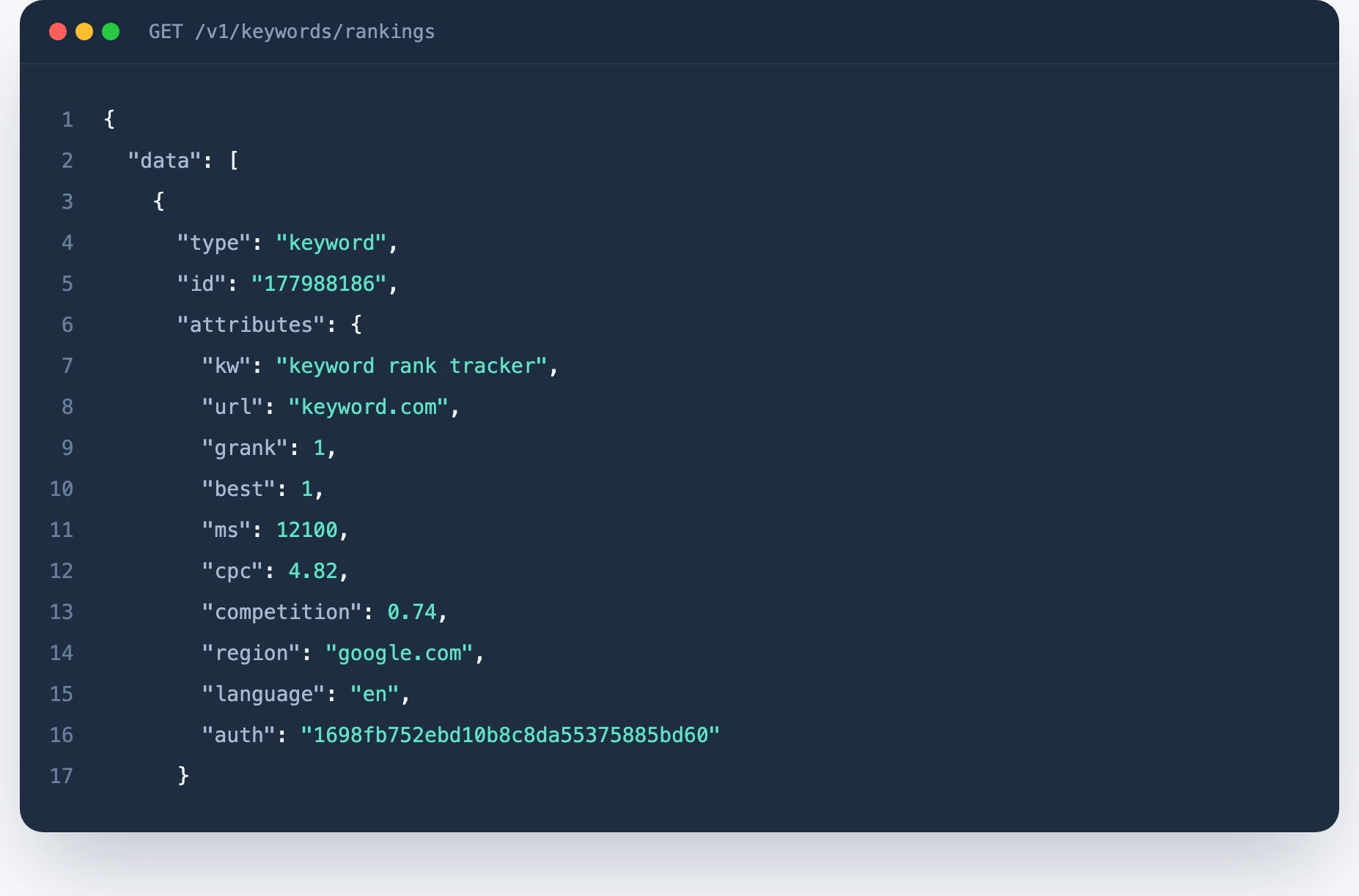
Have you ever tried to track your pages’ position on SERPs manually? The mental energy required can sap off your strength before you complete one-quarter of the task.
That’s where keyword.com rank tracking API comes in!
This tool helps you monitor how your keywords are faring on SERPs while you lie across your sofa back with your hands resting underneath your head.
Keyword.com API is a keyword rank tracking tool that pulls unlimited data from your account to track the performance of your keywords on SERPs. More so, it features a custom dashboard that makes it easy to compare your data with your own keyword metrics or other metrics based on your KPI.
Here is a review from one of its users:
“With Keyword.com, you can see your SERP history. You can see your competitors — who are in which positions. And you can analyze what they are doing. We can’t do this with Ahrefs.” Sander Jonkers, SEO Specialist at Juist.
In addition, this API provides full site export and 30-day historical SERP access. With this feature, you can save yourself the stress of downloading and importing data into your systems manually.
Pricing
Starts at just $3/month. A dedicated API-only pricing exists for extra affordable plans.
Note: You can track unlimited sites. None of the plans has a limit on the number of sites you can track. Start a 14-day free trial to explore this powerful tool.
2. Google Search Console API
Google Search Console API helps you debug your website’s performance on Google. This API provides reports and actions in your Search Console account and runs advanced queries for Google search result data.
Most importantly, the Search Console API offers four primary functions:
- Queries search traffic data – up to 1,200 queries per minute.
- View, add, remove, or request specific information about a sitemap.
- Make changes to properties on a Search Console account.
- Performs URL inspection – up to 2,000 requests each day and 600 requests per minute.
Let’s examine some use cases of the Google Search Console API:
- Keyword research: The Search Console API helps you analyze search queries and identify keywords that drive traffic to your website. You can maximize this information to optimize content and improve search engine rankings.
- Competitor analysis: The API allows marketers to compare their website’s performance to their competitors. This data can be used to identify areas where your website is lagging and make adjustments accordingly.
- Technical SEO: The Search Console API can identify technical issues on a website, such as crawl errors and broken links. Fixing these issues can improve a website’s search engine visibility and user experience.
- Link building: The API provides data on inbound links to a website, including the domains and pages linking to the site. Marketers can identify opportunities for link-building and outreach with these data.
- Performance tracking: The API allows marketers to track their website’s performance over time, including metrics like clicks, impressions, and average position. They can use these data to measure the effectiveness of their marketing campaigns and make adjustments as needed.
- Mobile optimization: The API provides website performance data, including usability issues and search engine visibility. This information can be used to optimize a website for mobile devices, which is becoming increasingly important in today’s mobile-first world.
Read the API doc for complete details.
Pricing
The Google Search Console API is free but subject to usage limits.
3. PageSpeed Insights API
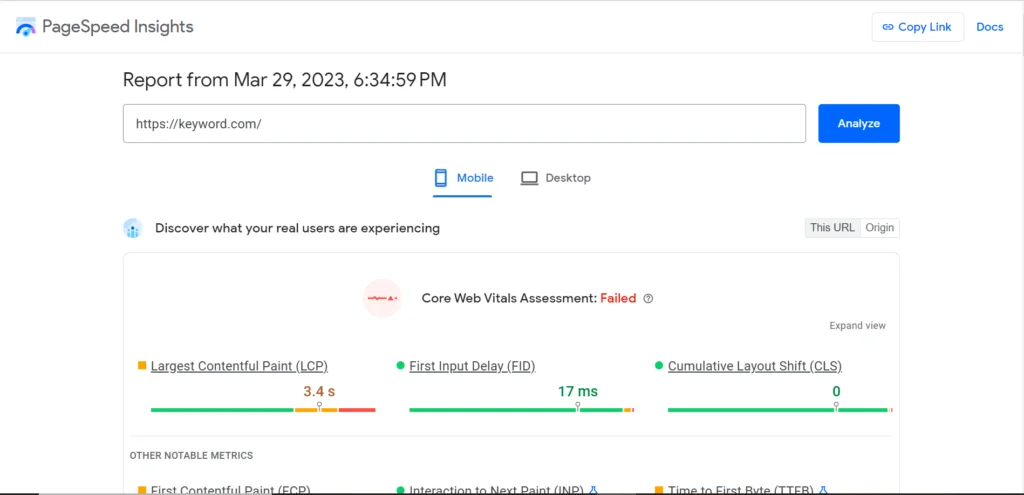
Google’s ranking factor guidelines reveal website speed as a crucial element in improving a site’s SERPs position.
“Like us, our users place a lot of value in speed—that’s why we’ve decided to consider site speed in our search rankings.”
Pagespeed Insights API measures the loading speed of a site’s pages and performs in-depth mobile and desktop performance diagnosis. Interestingly, the reports come with suggestions for improvement.
This API collates data from the Chrome Users Experience Report and Lighthouse.
As of October 2025, PageSpeed Insights and the API run on the latest version of Google’s open-source auditing engine, Lighthouse 13.0.
The Pagespeed Insights API performs for analysis:
-
Performance: Pagespeed Insights calculates a site’s performance based on First Contentful Paint, Page Index, Largest Contentful Paint, Total Blocking Time, and Cumulative Layout Shift.
-
Accessibility: This report provides opportunities to improve your pages’ accessibility.
-
Best Practices
-
SEO: You can identify missing tips to increase your search rankings.
You don’t need to set up an API key to try the PageSpeed Insights API. However, if you perform multiple queries, you must create one. By default, you can make 25,000 queries per day and 400 requests per 100 seconds.
Pricing
It’s free.
4. SE Ranking API
SE Ranking API goes beyond traditional rank tracking or keyword lookup tools. It gives you two distinct APIs under a single subscription: a Data API for large-scale retrieval of backlinks, domain analysis, keyword research, website audit data, and AI search visibility; and a Project API for automating SEO workflows inside the SE Ranking platform itself.
It also offers a dedicated AI Search API. While most SEO APIs focus on traditional search data, SE Ranking lets you track how brands and domains appear across ChatGPT, Gemini, Perplexity, AI Overviews, and AI Mode — useful for teams building automated GEO reporting.
The API covers a wide surface area:
- Domain Analysis — ranking distribution, competitor keyword gaps, and historical data across 188 countries
- Backlinks — referring domains, authority metrics, new/lost link tracking, batch retrieval for multiple targets
- Keyword Research — search volume, CPC, difficulty, related and question-based keyword suggestions
- Website Audit — standard HTML crawl and JavaScript-rendered crawl, with health scores and page-level issue breakdowns
- AI Search API — brand discovery, prompt tracking, and Share of Voice leaderboard across major LLM engines
- Project API — rank tracking, keyword group management, competitor monitoring, and sub-account management
For teams that prefer no-code automation, SE Ranking offers pre-built connectors for Looker Studio, n8n, and Make.com. It also has an MCP server that lets you query live SEO data in plain English directly from AI assistants like Claude, ChatGPT, or Cursor.
Pricing
API access is included in every SE Ranking plan (Core plan at $129/mo and Growth plan at $279/mo). Pay-as-you-go starts at a $50 minimum deposit. An API Add-On is available from $149/month, and a standalone API plan starts at $179/month. A 14-day free trial includes 100K API credits with full endpoint access.
5. Ahrefs API
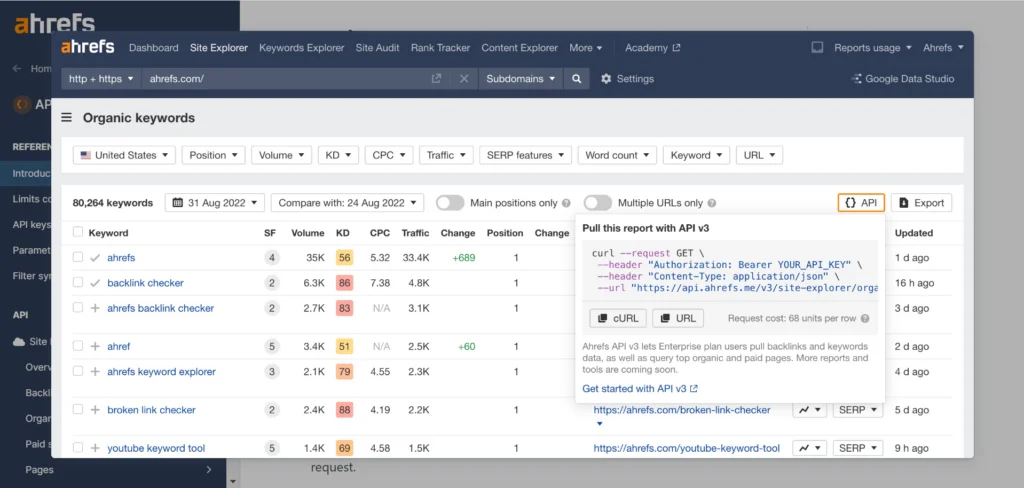
Ahrefs API allows its users to access data from the Ahrefs index.
Ahrefs runs AhrefsBot, one of the most active web crawlers on the internet, processing around 5 million pages every minute. Its backlink index spans roughly 494 billion pages and trillions of tracked links.
You can develop applications that use Ahrefs API on behalf of Ahrefs users or integrate third-party applications to use Ahrefs API on your behalf.
Ahrefs recently released the latest version of their API – Ahrefs v3. This version allows users to extract data from Site Explorer, Keywords Explorer, and SERP Overview endpoints.
Each API request requires units, and you will need an API key to send requests to the API. The cost for any request varies in units, with a standard minimum price of 50 units.
Read the API doc for the latest version.
Pricing
API v3 access is included as a monthly units allowance on Ahrefs’ standard subscription plans — from 100,000 units/month on Lite up to 2,000,000 on Enterprise — with a minimum of 50 units per request. There are no separate standalone API price tiers.
6. Seobility API
Seobility offers a Ranking Monitoring API that gives programmatic access to the ranking data in your Seobility account. It’s available to customers on Seobility’s Agency plan, with access granted on request.
The API is focused on rank tracking — it returns the keyword positions Seobility monitors for your projects across desktop and mobile, including AI Overview results. It doesn’t include backlink data and offers only limited on-page data, so it’s best suited to teams that want to pull Seobility’s rank-tracking numbers into their own dashboards or reports.
Note: Seobility’s older standalone, credit-based SEO API (which covered SEO checks, TF*IDF, and keyword analysis) has been deprecated in favor of this account-based offering.
Pricing
API access is tied to Seobility’s Agency plan (€179.90/month, or €1,727/year), which includes ranking monitoring for 1,500 keywords and up to 30 competitors per project. Seobility also offers a free Basic plan and a Premium plan (€49.90/month), though API access is limited to Agency subscribers.
7. SerpApi
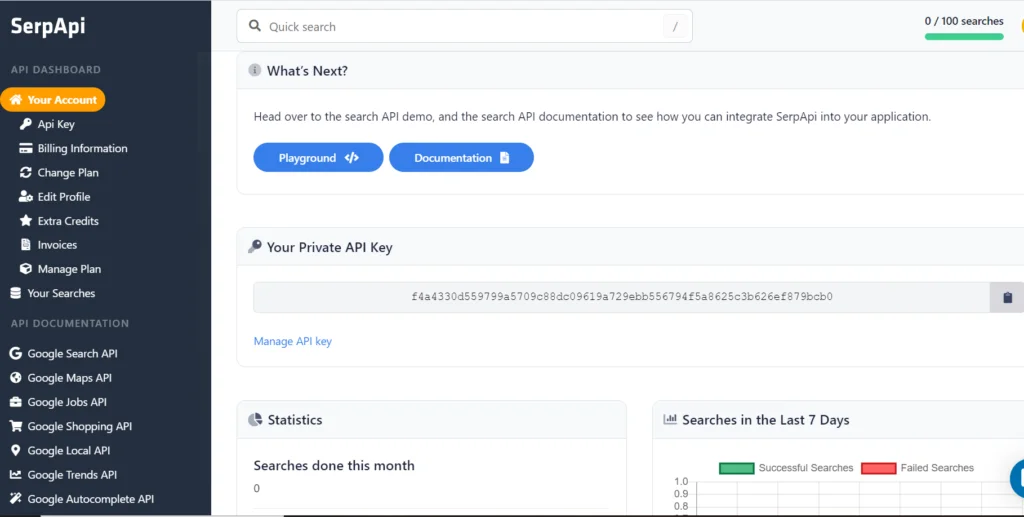
SerpAPI helps you scrape Google and other search engines for relevant information to boost your SEO and marketing strategy.
We mean what we are saying when we talk about this API’s capability to scrape search engines. SerpAPI features tens of APIs such as Google Search API, Google Map API, Google Lens API, Baidu Search API, Yandex Search API, Bing Search API, and more.
Most importantly, this API can be integrated with different languages, including Python, Java, Ruby, and more.
The API provides a site’s or keyword ranking on SERPs, local stats to improve local marketing decisions, extracts relevant data to boost SEO campaigns, and more.
SerpAPI features a Ludicrous Speed that automatically creates parallel proxy requests and provides super-quick JSON results.
Read the API doc for more details.
Pricing
- Free – $0 (250 searches/month)
- Starter – $25 (1,000 searches)
- Developer – $75 (5,000 searches)
- Production – $150 (15,000 searches)
- Big Data – $275 (30,000 searches)
- Enterprise – custom
Final Words
Due to the lack of a single application that can provide a marketing team with all the data they require in a streamlined manner, an API paired with SEO software enables them to link two sales platforms. More so, it helps to create more strategic insights into the efficiency of the sales force.