Since early September 2026, our rank tracker has been receiving a kind of Google results page we had rarely seen before. The page looks complete. It has organic results on the right topic, no error and no CAPTCHA. But most of the domains that usually rank for the keyword are missing, and on a later check they are back in their positions.
We measured how often this happened in Keyword.com’s data between August 13 and October 14, 2026, using a definition adapted from Nozzle’s report on poisoned Google SERPs. From September 13 to October 14, 13.1% of the SERPs in our study met that definition. In August the figure was 0.3%. On the worst day, September 30, it was 34%.
The definition we used
A poisoned SERP is a Google results page that looks complete but is missing most of the domains that normally rank for that keyword. The organic results can still relate to the topic, which makes the problem hard to spot from a single page.
A blocked request gives a rank tracker an obvious failure, such as an error or a CAPTCHA. A poisoned SERP contains results the tracker can read and record. If your domain is missing from those results, the check looks like a ranking loss.
For this study, we identified the domains that held each keyword’s top-10 positions during a baseline period. We flagged results where fewer than half of those domains remained, then required their return on a later check before classifying the SERP as poisoned. The full thresholds and dates are in the methodology below.
Two waves in September
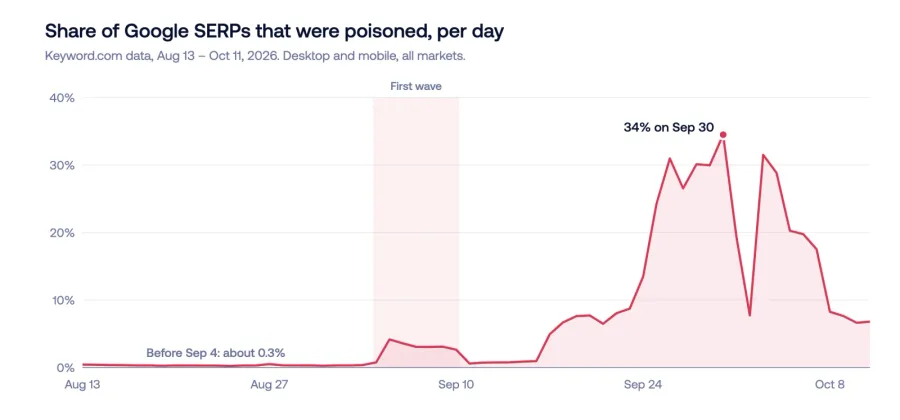
The increase came in two waves, with the largest spike at the end of September. Before September 4, about 0.3% of SERPs matched the definition, which gave us a baseline. From September 4 to 10, the rate rose to 3-4%, then fell below 1% on September 11. This earlier wave appeared across the markets and keyword groups in our data, and it behaved the same way as the later one: familiar domains lost their positions, then returned within days.
From September 17 to early October, the rate reached 5-8%, jumped on September 25, and peaked at 34% on September 30. From October 8, the rate fell to about 7-8%. That was well below the peak, but still more than 20 times the August level.
Our SERP Volatility Index recorded the same two waves. It measures how far rankings moved since the previous day across all daily-tracked keywords, so a page where the usual domains vanish pushes it up. The index climbed from 13 on September 3 to 38 on September 10, fell to 8 on September 13, then rose from September 17 to a peak of 79 at the end of September. It did not return to the 30s until October 9.
That first wave matters when you choose a comparison period. Early September already included affected results, so it may not give you a reliable picture of a keyword’s usual rankings.
What changes on the page
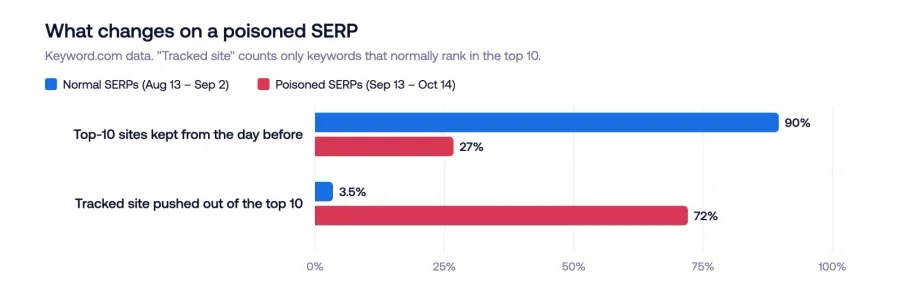
The biggest difference was which domains held the organic results. On a normal day, 90% of a keyword’s top-10 domains were still there the next day. On a poisoned SERP, that figure fell to 27%. For keywords where the tracked domain normally ranked in the top 10, it was outside the top 10 on 72% of poisoned SERPs. During the normal period, that happened 3.5% of the time. Within three days, 78% of poisoned SERPs had their usual domains back, close to the 77.9% reported by Nozzle.
For an agency, this can look like several clients losing ground at once. Check whether the whole group of familiar competitors lost their positions alongside your client. That tells you more than the tracked rank alone.
Which domains take the empty positions
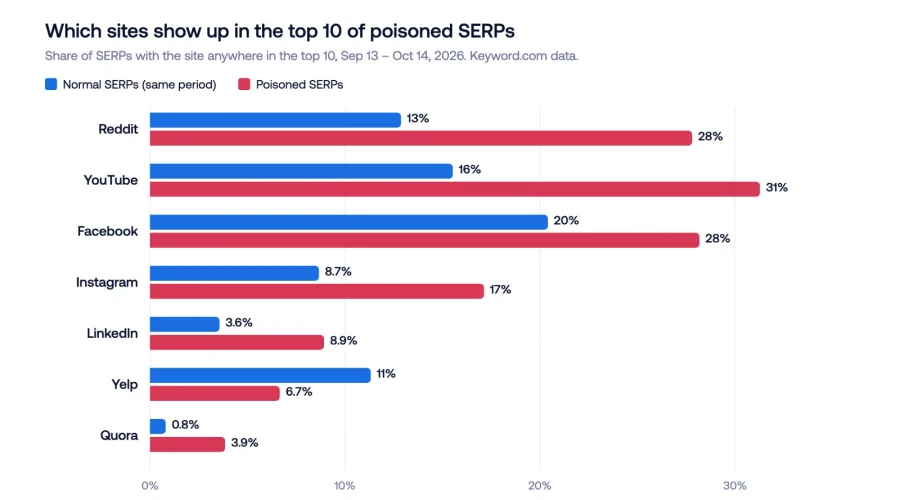
Social platforms and forums took more of the top-10 positions when the usual domains were missing. Reddit appeared in the top 10 on 28% of poisoned SERPs, compared with 13% of normal SERPs in the same period. YouTube appeared on 31%, compared with 16%. That is nearly twice as often, whereas Nozzle recorded a slight decline. We don’t have an explanation for the difference. Instagram, LinkedIn and Quora appeared roughly two to five times as often. Yelp appeared less often: 6.7% compared with 11%.
If Reddit threads, YouTube videos and Facebook pages suddenly hold the positions where a client’s usual competitors ranked, compare that page with the keyword’s history.
SERP features on poisoned pages
A poisoned page can still contain familiar features such as AI Overviews and People Also Ask. Their presence varied in our data:
| SERP feature | Normal SERPs | Poisoned SERPs |
|---|---|---|
| AI Overview shown | 64% | 69% |
| People Also Ask shown | 81% | 72% |
| People Also Ask kept from the day before | 94% | 82% |
| Image pack shown | 15% | 29% |
Sep 13 to Oct 14, 2026. “Normal SERPs” are the SERPs in the same period that were not poisoned.
Nozzle reported a decline in AI Overviews on poisoned pages, but our data showed a slight increase. We do not have an explanation for the difference. People Also Ask appeared less often, while image packs appeared nearly twice as often.
Start with which domains lost their positions and whether they returned. A page can look familiar while showing a very different set of organic results.
Devices, query types and markets
We found poisoned SERPs across every market, device and query type in our data, though the rates differed. The following figures cover September 13 to October 14, 2026:
| Group | Share poisoned |
|---|---|
| Desktop | 14.2% |
| Mobile | 10.4% |
| One-word keywords | 9.5% |
| Keywords with 3 or more words | 13.6-13.9% |
| “Near me” keywords | 15.9% |
| Other keywords | 13.1% |
| Keywords with a set location (city, ZIP or address) | 13.1% |
| Keywords without a set location | 13.2% |
Desktop checks had a higher rate than mobile checks. Longer queries and queries containing “near me” were also more affected. Setting a specific location made little difference: 13.1% with a location versus 13.2% without one.
Among the markets below, New Zealand, Canada and the United States had the highest rates in our sample:
| Google domain | Market | Share poisoned |
|---|---|---|
| google.co.nz | New Zealand | 16.1% |
| google.ca | Canada | 15.3% |
| google.com | United States | 15.0% |
| google.com.au | Australia | 14.1% |
| google.co.uk | United Kingdom | 14.0% |
| google.de | Germany | 13.1% |
| google.com.sg | Singapore | 11.5% |
| google.se | Sweden | 11.2% |
| google.com.hk | Hong Kong | 11.0% |
| google.com.ph | Philippines | 10.8% |
| google.nl | Netherlands | 10.1% |
| google.fr | France | 9.4% |
| google.co.th | Thailand | 9.3% |
| google.com.my | Malaysia | 8.8% |
| google.co.id | Indonesia | 8.7% |
| google.es | Spain | 8.0% |
Four checks before you report a drop
A rank tracker is one source of evidence. Cross-check what it shows against other sources before acting on a drop.
1. Compare the SERP with the keyword’s history
Open the organic results for the affected day and compare them with earlier checks. Look for two things: whether your client’s domain lost its position together with its usual competitors, and whether social platforms or forums took those positions.
Compare several days where possible. The previous day’s SERP may also have been affected. Widespread changes to the familiar results deserve a closer look, but they do not rule out a genuine ranking change.
2. Match the drop against Search Console
Review impressions and clicks for the affected query and date in Google Search Console. Match the country and device to the rank check where possible, rather than relying on domain-wide totals.
If those figures stayed steady while the rank tracker recorded a sharp drop, the drop is more likely in the collected page than in the rankings. Check the data’s last-updated date before drawing a conclusion from a recent day’s figures.
3. Watch the next few checks
In our study, 78% of poisoned SERPs had their usual domains back within three days. A quick return is useful evidence, especially when the same competitors reappear too. A high reading on the volatility index for the same day tells you the movement was broad, not limited to your keyword, though it cannot tell you whether the page was poisoned or Google changed its rankings.
If the drop persists or Search Console shows a corresponding decline, investigate it as a possible SEO issue. Our guide to keyword ranking fluctuations covers other causes to check.
4. Tell the client what you verified
Keep the affected SERP and the follow-up results together. Explain which domains lost their positions, whether they returned, and whether Search Console recorded a matching loss of visibility.
If the evidence is still incomplete, say what you’re checking next. You can give a client a useful update without presenting a suspected data issue as a confirmed ranking loss.
Check the page in Spyglass
Keyword.com’s Spyglass gives you SERP snapshots to review alongside your ranking history. Open an available snapshot for the affected keyword and date, then compare the organic results on that page with earlier and later ones.
This gives you something concrete to review with a client: the results behind the recorded position. Use the snapshot together with subsequent checks and Search Console data to assess whether the drop fits the pattern described in this study.
How we ran this study
We analyzed a sample of customer rank tracking data from August 13 to October 14, 2026, covering desktop and mobile across the markets in our dataset. Google Maps keywords were excluded.
Our baseline was August 13 to September 2. We chose a period before the first wave in our data on September 4. The baseline starts one week before Nozzle’s and ends before that early wave.
A keyword needed at least five SERPs during the baseline and at least one domain that usually ranked for it to qualify. Most keywords checked weekly had too few observations, so the study mainly covers daily tracking.
We applied these thresholds:
- Identify the usual domains. A domain qualified if it held a top-10 position for the keyword on at least 60% of days during the baseline.
- Flag the disappearance. A SERP became a candidate when fewer than half of those domains appeared anywhere in the collected results.
- Check for their return. We classified the candidate as poisoned if at least 80% of the usual domains returned on a later SERP within 14 days.
Some limits apply to everything above. Our numbers come from one rank tracker’s collected SERPs, so they can’t show what a real searcher saw on any of these days. They don’t test why Google serves these pages; Nozzle attributes the pattern to Google’s response to automated scraping, and we have no data of our own on that. Because a SERP only counts as poisoned after its usual domains return, the figures for the last days of the study will rise as later results arrive. The 78% recovery rate describes the cases that met our definition, and we don’t know whether an unexplained drop outside the study behaves the same way. Maps keywords are excluded, and most weekly keywords had too few baseline days to qualify, so the study mostly describes daily tracking.
In short
A sudden drop still needs a look. Find out whether the usual competitors lost their positions along with your client, and watch what the next checks bring back. With that in hand you can decide whether the page needs work and what to tell the client.