Most SEO agencies looking for a search visibility tool still treat AI search as a separate channel. In reality, search visibility now spans both Google and LLMs, and it needs to be tracked in one place.
Choosing a unified search visibility platform over separate rank tracker software reduces costs, shortens the learning curve for your team, and makes it easier to understand your clients’ search performance across Google and AI.
In this article, we’ll share five SEO tracking tools that provide Google and LLM tracking in one platform. We’ll discuss their pricing, AI and Google search features, and setup complexity to help you find the right fit for your organization.
Why Do SEO Agencies Need AI Visibility and Google SERP Monitoring in One Tool?
Here’s why smart SEO agencies choose search visibility tools that combine AI visibility and Google SERP monitoring in a single platform.
1. A Unified Search Tool Eliminates Fragmented Reporting
If your data lives in multiple tools, your reporting will always feel incomplete. When AI visibility and Google rankings are tracked separately, teams end up manually stitching insights together. That slows reporting cycles and makes it harder to present a single, confident narrative to clients. A unified search visibility tool removes that friction — giving you a holistic view of search performance that’s easier to scale across your clients’ accounts.
2. It Reduces Operational Overhead
Every extra tool adds hidden costs your team feels daily. It’s not just about subscription fees. New tools mean onboarding, training, internal documentation, and ongoing maintenance. For agencies juggling multiple clients, that overhead compounds quickly. Combining AI visibility and SERP monitoring in a single platform keeps workflows tight and reduces the operational drag that slows teams over time.
3. It Makes It Easier to Connect SERP Rankings to Actual Brand Visibility
Rankings alone don’t explain search visibility anymore, and neither does AI visibility data in isolation. Agencies need to understand how Google performance translates into AI-generated mentions (or why it doesn’t). When data is split, those relationships are harder to see. A unified tool lets you connect the dots — so you can move beyond surface-level metrics and give clients a clearer picture of their true search presence.
4. You Can Avoid Tool Sprawl as Search Evolves
Adding a separate tool now often means replacing or stacking more tools later. AI search is still evolving, and today’s “best standalone solution” can quickly become tomorrow’s redundant layer. Agencies that consolidate early avoid building a fragmented stack they’ll need to untangle later. A unified search visibility tool gives you flexibility to adapt — without constantly adding, replacing, or reworking your setup.
The Top 5 Search Visibility Tools That Track Google Search and LLMs
While many platforms still focus on Google rankings — or treat AI visibility as a separate add-on — the tools below are designed to cover both. They help agencies track performance across traditional SERPs and LLM-driven search in one place, without adding unnecessary complexity to existing workflows.
Below are the best search visibility tools for monitoring Google performance and LLM brand visibility — starting with the strongest all-in-one option.
1. Keyword.com: Best for Unified Search Visibility Tracking
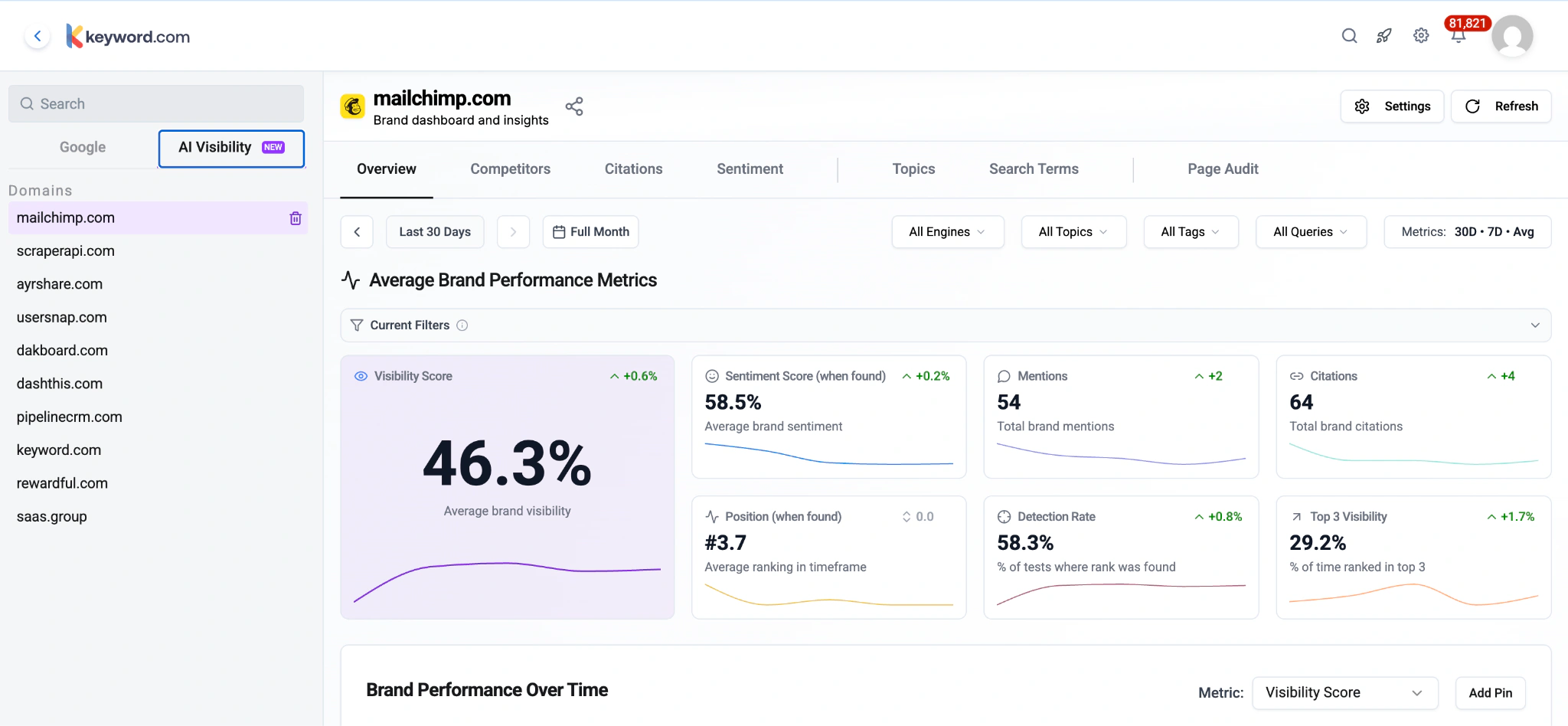
Which platforms does Keyword.com track?: Google SERPs, Google AI Overviews, Google AI Mode, ChatGPT, Perplexity, Gemini, Claude, Microsoft Copilot, DeepSeek, Mistral
Pricing: From $26 per month for unified search tracking
If your SEO agency is evaluating a search visibility tool and wants to avoid fragmenting your stack, Keyword.com is the strongest all-in-one option. It combines Google SERP tracking and LLM visibility in a way that’s practical, scalable, and agency-friendly.
For Google SERP monitoring, Keyword.com offers local rank tracking (by city, ZIP, and device), accurate daily and on-demand ranking updates, and SERP features tracking for AI Overviews, featured snippets, etc.
For AI brand monitoring, Keyword.com lets you track your brand mentions and citations across ChatGPT, Perplexity, Google AI Mode, AI Overviews, and more. It supports prompt tracking, AI sentiment analysis, and competitor benchmarking.
Beyond raw rankings and AI brand monitoring, Keyword.com is designed to fit directly into your agency’s workflows. You can segment keywords by client, campaign, or intent, and pull that data into clean, automated SEO reports and keyword dashboards to share with clients.
Here’s what one of our customers says about using Keyword.com for search visibility monitoring — one of many customer reviews we publish in full.
What I really like about Keyword.com is how simple and accurate it is. The dashboard is super clean and easy to use. I can quickly see how my keywords are performing across different search engines and locations. The daily ranking updates and competitor tracking help me stay on top of changes without having to dig through complicated data. I also love how easy it is to share reports with clients. It saves a ton of time and keeps everyone on the same page. Overall, it’s reliable, fast, and just makes SEO tracking feel effortless. — G2 Review
What Features Does Keyword.com Offer for Google and AI Brand Monitoring?
- Accurate keyword rank tracking: Monitor keyword positions in real time with daily or on-demand updates, so you can catch fluctuations and validate changes quickly.
- Local and device-level tracking: Track rankings by city, ZIP code, and device to reflect how users actually see results in different markets.
- SERP feature tracking: See how your brand appears across featured snippets, People Also Ask, image packs, and AI Overviews — not just blue links.
- Share of voice and competitor insights: Understand how much SERP real estate you own compared to competitors and where you’re losing visibility.
- White-label reporting and keyword dashboards: Turn ranking data into client-ready reports without extra manual work.
- Cross-platform AI visibility tracking: Monitor how your brand appears across ChatGPT, Perplexity, Gemini, Claude, and Google AI Overviews.
- Brand mention and citation tracking: See where your brand is cited, which pages are referenced, and how often you appear in AI-generated answers.
- Competitor benchmarking in AI results: Compare your visibility and citations against competitors to identify gaps and opportunities.
- Sentiment analysis: Understand how AI systems describe your brand — positive, neutral, or negative — and how that evolves over time.
- Prompt tracking and insights: Track performance across real user prompts to understand how your brand shows up in actual AI search behavior.
How Much Does Keyword.com Cost?
You can try Keyword.com for free for 14 days.
- Search Visibility: $6/month (Google only, AI credits available as add-on)
- 360° Visibility: $26/month (Google + AI credits bundle)
- AI Visibility: $31.17/month (AI only, no Google tracking)
- Custom: From $490/month
2. Semrush: Best for All-in-One SEO and Market Intelligence
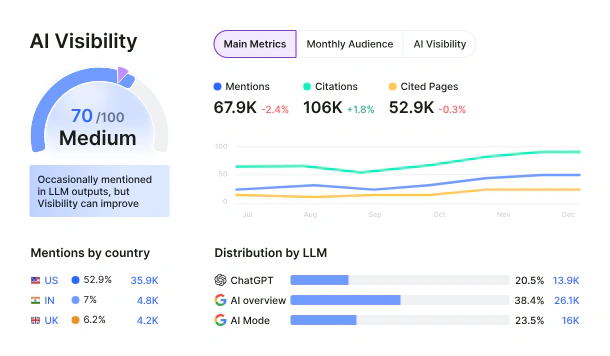
Which platforms does Semrush track?: Google (primarily), Bing, Baidu, ChatGPT, Perplexity, Gemini, and Google AI Overviews
Pricing: From $199 per month
If you’re looking for a powerful, all-in-one platform that combines traditional SEO with expanding AI visibility capabilities, Semrush is one of the most established and feature-rich options — though often more complex than tools built purely for streamlined visibility tracking.
Semrush is ideal for agencies that want a single platform to manage multiple aspects of digital marketing, not just search visibility. It’s particularly strong for teams that value:
- Competitive intelligence
- Content and keyword strategy
- End-to-end SEO workflows
However, this feature depth comes with a high cost and steep learning curve. Several user reviews suggest that Semrush is expensive, especially for growing agencies, and that it has too many features, making it time-consuming to set up and use effectively. This is overkill for agencies that need a simple, accurate platform for monitoring search visibility.
What Features Does Semrush Offer for Google and AI Brand Monitoring?
- Position Tracking: Tracks up to 5,000 keywords per project by location and device, with daily updates and alerts
- AI Visibility Toolkit: Monitors brand mentions, sentiment, competitors, prompts, and citations across AI platforms
- My Reports: Builds white-label dashboards using Google Search Console, GA4, and Semrush data
- API Access: Connects Semrush data to your existing dashboards and workflows
How Much Does Semrush Cost?
Semrush offers a seven-day free trial. The paid plans include:
- Semrush One Starter: $199/month. 5 websites, 500 keywords, 50 prompts daily
- Semrush One Pro+: $299/month. 15 websites, 1,500 keywords, 100 prompts daily, historical data included
- Semrush One Advanced: $549/month. 40 websites, 5,000 keywords, 200 prompts daily
- AI Visibility Toolkit standalone: $99/month per domain as an add-on to existing SEO plans
- Classic SEO plans available from $139.95/month without AI Visibility
Semrush Pros
- Deep search engine visibility data across keyword research, rank tracking, site audits, and competitive intelligence in one place
- Agencies already on Semrush get AI visibility without a new platform, contract, or reporting format
Semrush Cons
- The interface is dense and has a steep learning curve
- Per-domain and per-user pricing on AI Visibility adds up fast if your agency manages large client rosters
Related: Semrush vs. Keyword.com: which tool is better for search visibility tracking?
3. AccuRanker: Best for High-Accuracy Rank Tracking at Scale
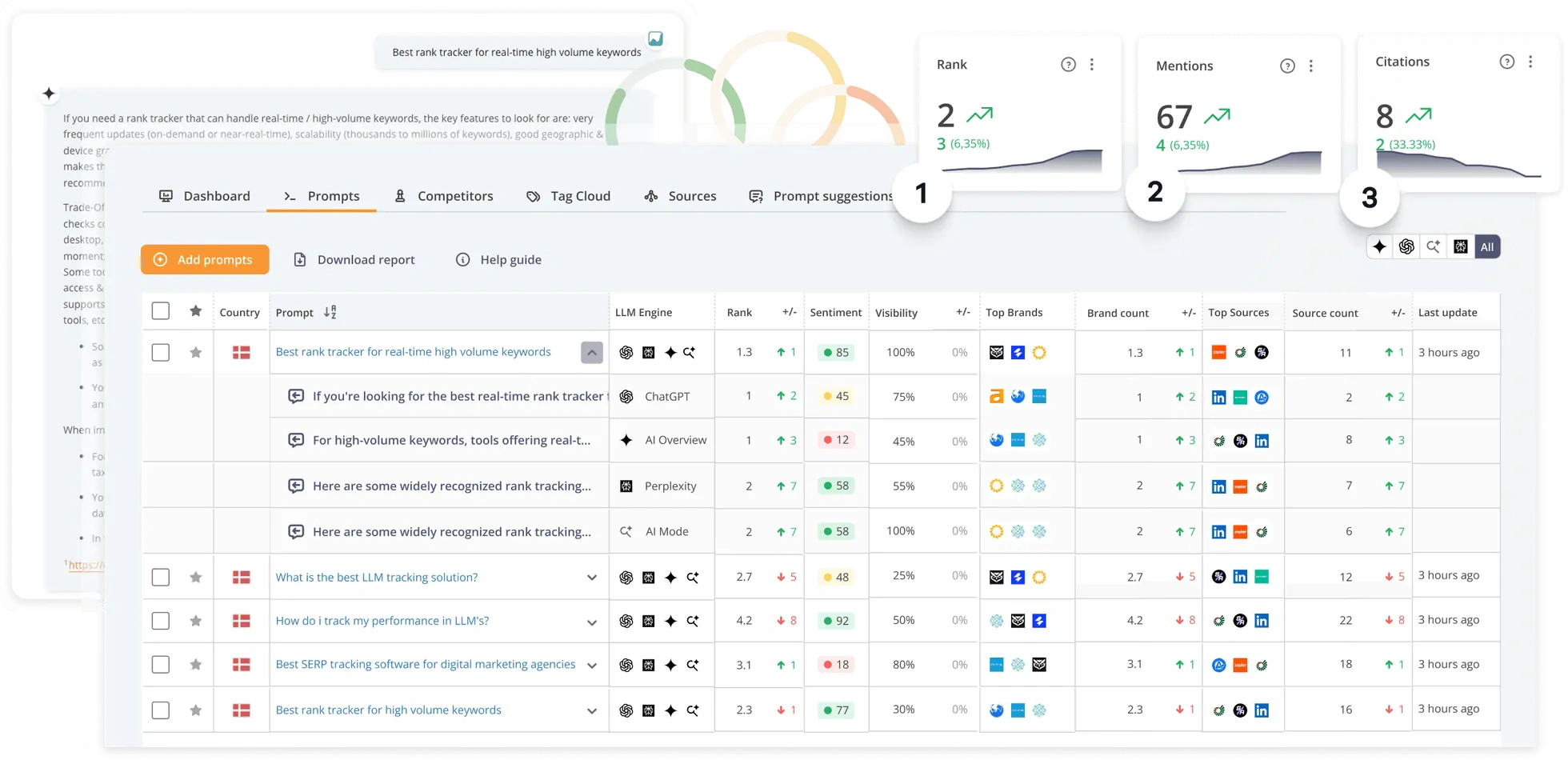
Which platforms does AccuRanker track?: Google SERPs, Google AI Overviews, Google AI Mode, ChatGPT, Perplexity
Pricing: From $206 per month
AccuRanker is a search visibility tool built around one core strength: fast, highly accurate rank tracking. It’s widely used by agencies that need reliable keyword data at scale, especially across large client portfolios.
In addition to its core SERP tracking, AccuRanker has introduced AccuLLM, an AI visibility feature that lets you monitor how brands appear across platforms like ChatGPT, Perplexity, and Google AI Overviews.
That said, AccuRanker has separate billing plans for Google and AI brand monitoring, so pricing scales quickly, especially when you’re tracking multiple brands. This means that while AccuRanker starts at $249/month for 2,000 keywords, costs can quickly climb past $849/month once you move to the Expert plan and add AI visibility as a separate layer — whereas tools like Keyword.com bundle both Google and AI tracking into a single system that typically starts much lower and scales more predictably.
What Features Does AccuRanker Offer for Google and AI Brand Monitoring?
- On-demand rank updates: Refresh a keyword or full domain anytime, not just on scheduled updates
- AccuLLM: Tracks brand mentions, sentiment, sources, and competitor visibility across major AI platforms, with prompt suggestions
- Web search rate monitoring: Indicates when LLMs use live search vs training data for your prompts
- Forecasting: Estimates traffic, conversions, and revenue from ranking improvements
How Much Does AccuRanker Cost?
- Professional: $249/month ($224 billed annually). 2,000 to 5,000 keywords, daily updates
- Expert: $849/month ($764 billed annually). 10,000 to 25,000 keywords
- Enterprise: Custom pricing above 25,000 keywords
AccuRanker Pros
- Unlimited users and domains across all plans keep agency costs predictable as you scale
AccuRanker Cons
- AccuRanker comes with a relatively high starting price, and there is no free plan or trial to test it first
- Offers separate pricing for SEO and GEO, which makes the cost feel like you’re paying for separate tools
Related: The best AccuRanker alternatives for SEO agencies
4. SEOmonitor: Best for Forecasting and Unified Performance Tracking
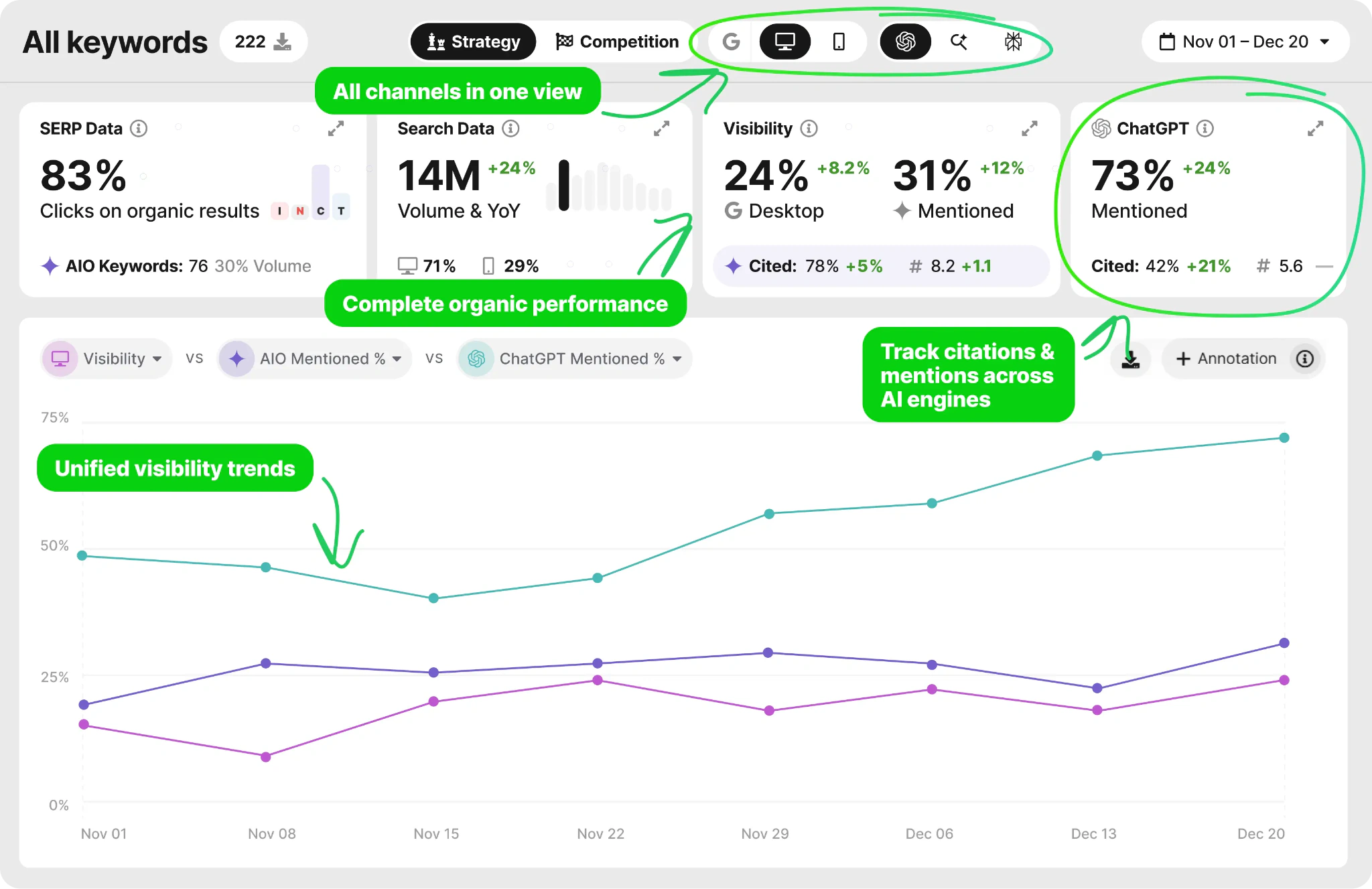
Which platforms does SEOmonitor track?: Google SERPs, Google AI Overviews, ChatGPT, Gemini, Perplexity
Pricing: From €99 per month
SEOmonitor is a search visibility tool designed for agencies that combines rank tracking, forecasting, and AI-driven visibility into a single, unified system.
What makes it different is its focus on connecting performance data to business outcomes — not just showing rankings, but helping teams understand what those rankings mean for traffic, growth, and opportunity.
Instead of rebuilding prompt lists from scratch, SEOmonitor lets you reuse your existing keyword set, saving hours of manual setup. When you track a keyword, it automatically captures how your brand appears across AI prompt variations tied to the same intent.
The forecasting tool connects rankings to projected traffic, conversions, and revenue, making it easier to support client pitches. It also connects data from Google Search Console and Google Analytics to estimate which keywords are driving traffic and conversions.
What Features Does SEOmonitor Offer for Google and AI Brand Monitoring?
- Keyword-based AI tracking: Your existing keyword strategy automatically covers AI visibility
- Unified dashboard: Google rankings, AI Overview presence, and AI search brand mentions sit in one view, weighted by search volume for accurate prioritization
- Competitor detection: Automatically identifies and tracks which competitors are being cited in AI Overviews and AI search responses across your tracked keyword set, including competitors you did not manually select
How Much Does SEOmonitor Cost?
SEOmonitor offers a 14-day free trial. Annual paid plans include:
- Starter: €99/month. 1 website, 1,000 to 3,000 daily tracked keywords, AI search tracking not included
- Pro: €299/month. Unlimited campaigns, 3,000 to 200,000+ daily tracked keywords, AI search tracking available at €19 per 1,000 keywords
SEOmonitor Pros
- No per-seat fees means the whole team gets access without the bill growing as you hire
SEOmonitor Cons
- Priced in euros, which adds cost variability and makes it more expensive for agencies outside Europe
- Users note that it takes time to understand which features to use, and the platform can feel slow in day-to-day use
5. Nightwatch: Best for Flexible Rank Tracking and Reporting
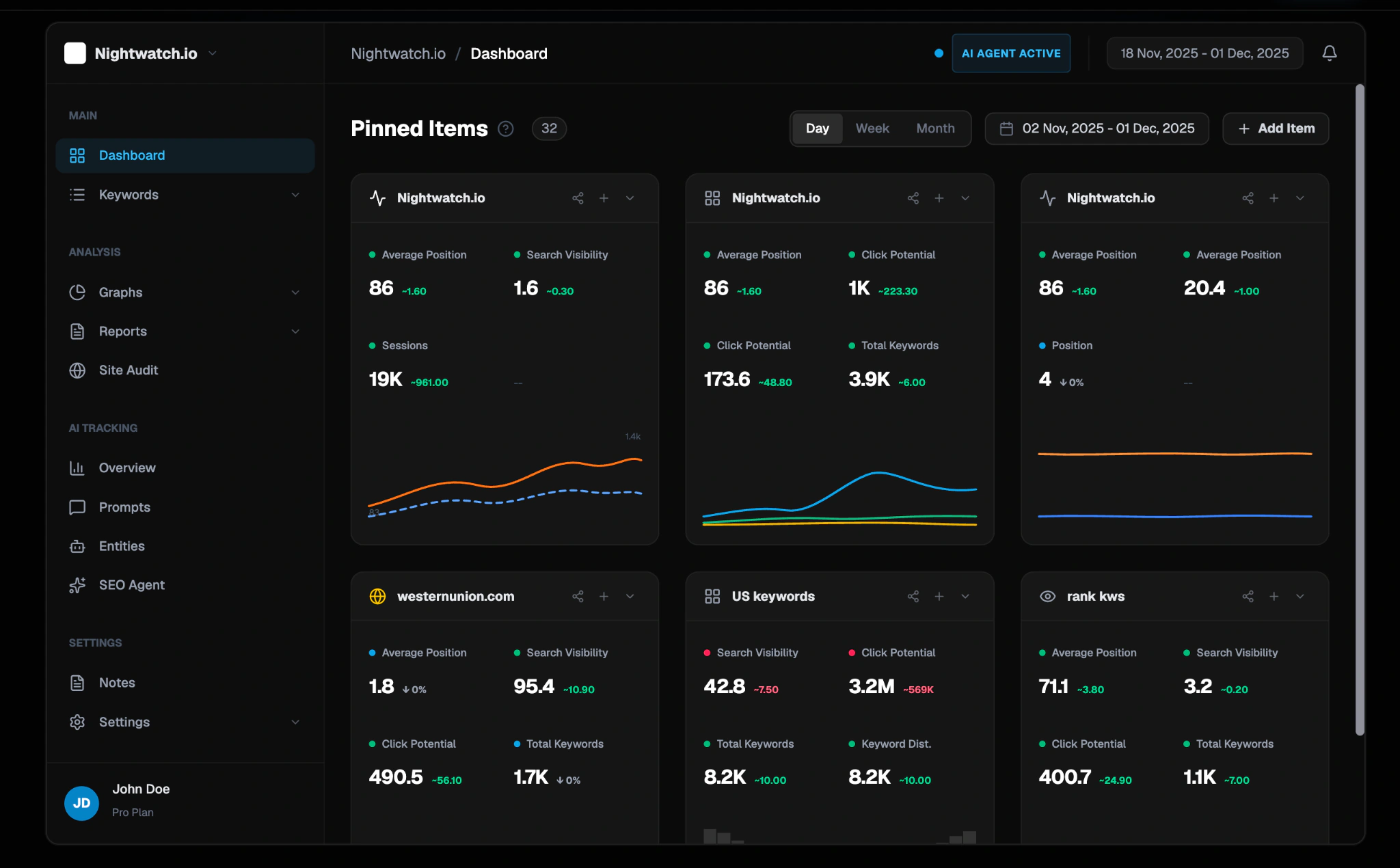
Which platforms does Nightwatch track?: Google SERPs, Google AI Overviews, Google AI Mode, ChatGPT (GPT-4o-mini), Claude (3.5 Haiku), Perplexity
Pricing: From $32 per month
Nightwatch is built for teams that want control and flexibility. You can:
- Segment keywords in highly customized ways
- Build tailored dashboards for different clients
- Create reports that match your agency’s exact structure
It also balances depth with usability, making it easier to adopt than more complex platforms.
For Google SERP monitoring, Nightwatch offers daily rank tracking with high accuracy, local and device-based tracking, and detailed SERP feature insights — along with flexible segmentation and customizable dashboards. For AI brand monitoring, Nightwatch offers early-stage tracking of AI-driven search visibility, including monitoring appearances in Google AI Overviews and emerging LLMs.
What Features Does Nightwatch Offer for Google and AI Brand Monitoring?
- NightOwl AI SEO Agent: Runs autonomously across client sites, handling keyword research, audits, and competitor analysis
- White-label reporting: Custom reports (PDF, CSV, HTML) with client portals, scheduling, and Looker Studio integration
- Prompt research: Identifies prompts likely to trigger AI mentions of your brand, aligning with your existing keyword strategy
How Much Does Nightwatch Cost?
Nightwatch offers a 14-day free plan. Annual paid plans include:
- Starter: $32/month. 250 keywords daily, 50 websites
- Optimize: $82/month. 1,000 keywords daily, 200 websites
- Agency: $559/month. 10,000 keywords daily, 1,000 websites
- Enterprise: Custom pricing. 20,000 to 100,000+ keywords
Nightwatch Pros
- Clean interface and fast setup
Nightwatch Cons
- AI tracking features are too new and not as data-rich as competitors
- Report customization has limits. If your clients expect visually rich deliverables, you may hit a ceiling
How to Choose the Best Search Visibility Tool for Your SEO Agency
Every tool on this list tracks both Google rankings and AI visibility. The differences come down to pricing, depth of AI features, reliability, and ease of use. Here’s what to consider before committing.
1. Pricing Model at Scale
Most agencies underestimate how quickly costs compound once you move beyond a few clients. Pricing isn’t just about the entry tier — it’s about how the tool behaves as your keyword volume, client count, and reporting needs grow.
Some tools charge per keyword, others per domain or per user, and some layer additional costs for AI visibility. For example, Semrush charges extra for AI visibility per domain and per user, in addition to its base plan. SEOmonitor scales with the number of keywords tracked, while Keyword.com bundles Google and AI visibility into a single plan with unlimited users and domains from the start.
Instead of looking at base pricing, model your real usage:
- How many keywords will you track per client?
- How many clients will you onboard in the next 6–12 months?
- Will you need multiple users accessing the tool?
- Is AI visibility included or an add-on?
Then ask: Does this pricing model scale cleanly with my agency or will I need to constantly adjust plans, limit usage, or absorb rising costs?
2. Data Quality and Accuracy
Inconsistent search visibility data erodes clients’ trust. Many SEO tools will claim accuracy, but in practice, data quality varies based on:
- Update frequency (daily vs near real-time)
- Location precision (true local results vs averaged data)
- SERP coverage (features, AI Overviews, etc.)
- LLM tracking methodology (api vs prompt scraping)
For example, many enterprise tools like Semrush are known for large datasets and broad coverage, but that can sometimes come at the cost of complexity or slower validation cycles. On the other hand, more focused tools (such as dedicated rank trackers) tend to prioritize precision and freshness, especially at the keyword level.
Instead of taking accuracy claims at face value, test:
- Do rankings match what you see manually (incognito, location-specific)?
- How often does the data update — and can you refresh it on demand?
- Are AI visibility insights tied to real prompts or abstract scoring?
- Can you explain the data clearly to a client without caveats?
3. Onboarding and Learning Curve
The harder a tool is to adopt, the longer it takes to deliver value. In evaluation mode, ramp-up time often gets overlooked, but it shows up fast once you commit. A tool might look powerful on paper, but if your team needs weeks to onboard, configure, and learn it, you’re delaying results (and adding internal friction).
Use customer reviews to get a clear idea of how long onboarding is and the tool’s time-to-value. For example, Keyword.com users say that it’s super easy to get started with our rank tracker software.
What I like most about Keyword.com is how easy it is to get started and immediately see value. The UI is clean and intuitive, better than a lot of other vendors I’ve used, so you’re not fighting the software just to set up a simple tracking system.
Keyword.com: The All-in-One Search Visibility Tool That Scales with Your Agency
Across the tools we’ve covered, the differences come down to a few things: how well they handle both Google and AI visibility, how much operational overhead they introduce, and how easily they scale as you add more clients.
That’s where Keyword.com consistently comes out ahead.
It focuses on the core job: accurate rank tracking, clear reporting, and AI visibility — without adding unnecessary complexity. You’re not paying for a full marketing suite you won’t use, or managing separate systems for different types of visibility. Everything lives in one place, in a format your team already understands.
This translates into:
- Faster onboarding
- More comprehensive search visibility reporting
- Less time managing tools
- More consistency across clients
If your goal is to track both Google and AI visibility without adding friction to your team’s day-to-day, Keyword.com is the most practical choice. Get started with a 14-day free trial.