We’ve seen some of our rank tracker customers exploring the idea of building their own. That prompted us to write this article: what does it cost to build one and keep it running?
If your agency has a developer, it can look like a small project. Call a SERP API (a service that returns Google results pages on request), save the rankings, and display them in Looker Studio or a vibe-coded dashboard.
That gets you a first version. When results look wrong or a report stops updating, your developer has another system to fix.
In the agency example below, the SERP API pages alone cost more than Keyword.com’s API plan, even without engineering or hosting. Maintaining the tracker adds more. Use the calculation below to compare the options with your own numbers.
Why building your own rank tracker has become more expensive
Google has made several changes that affect the cost and reliability of automated rank checks.
-
Google began requiring JavaScript for Search
Tools that depended on the previous behavior lost access to results until they adapted. Search Engine Land reported data gaps across SEO tools. For a team running its own tracker, this is maintenance work that can arrive without warning.
-
Google removed
num=100This parameter had let tools request a hundred results on one page. A Top 100 check now needs roughly ten pages. The removal changed how tools collect deeper rankings, and SERP APIs changed their billing too. One public billing update took effect on September 19, charging for each ten-result batch instead of a hundred-result batch.
-
Google began replacing direct result links with
/gotoredirectsGoogle confirmed the rollout on August 26. An affected organic link points to
google.com/goto?url=…, hiding the destination behind a token. Your tracker must recover the real URL before matching the ranking page. Otherwise, it can record Google as the ranking site or miss your client's result. A visible domain or shortened breadcrumb does not reliably identify the exact page, as public tests of these redirects show. -
Poisoned results appeared
These are normal-looking Google pages where most of the usual ranking sites are missing. A tracker can read the page successfully and still tell a client that their rankings have collapsed. On a later check, the missing sites may be back.
In our study of poisoned Google SERPs, 13.1% of the result pages we studied from September 13 to October 14, 2026 met our definition of poisoning. That describes our study sample, not the rate every tracker will see.
A failed request is easy to notice. A complete page with misleading results is harder. Your tracker needs a way to spot suspicious changes and check them again before they reach a client report. Those extra checks cost money too.
-
Resolving those links became less reliable
Public incident reports described delays when following
/gotoredirects, documented in Search Engine Journal's November 5 report. These were observed limits, not a Google-confirmed specification. A successful API response can still contain unresolved links. Your system needs checks, retries, and a way to mark a destination as unknown instead of reporting a lost ranking. Resolving the links also does not tell you whether the result page itself was poisoned.
How to calculate the monthly cost of building your own rank tracker
Start with result pages, developer time, and hosting. Divide the price per thousand pages by a thousand for the formula. If your API charges separately to resolve /goto links, add that bill too; the model below excludes it. Some APIs include resolution, but you still need to check for unresolved URLs.
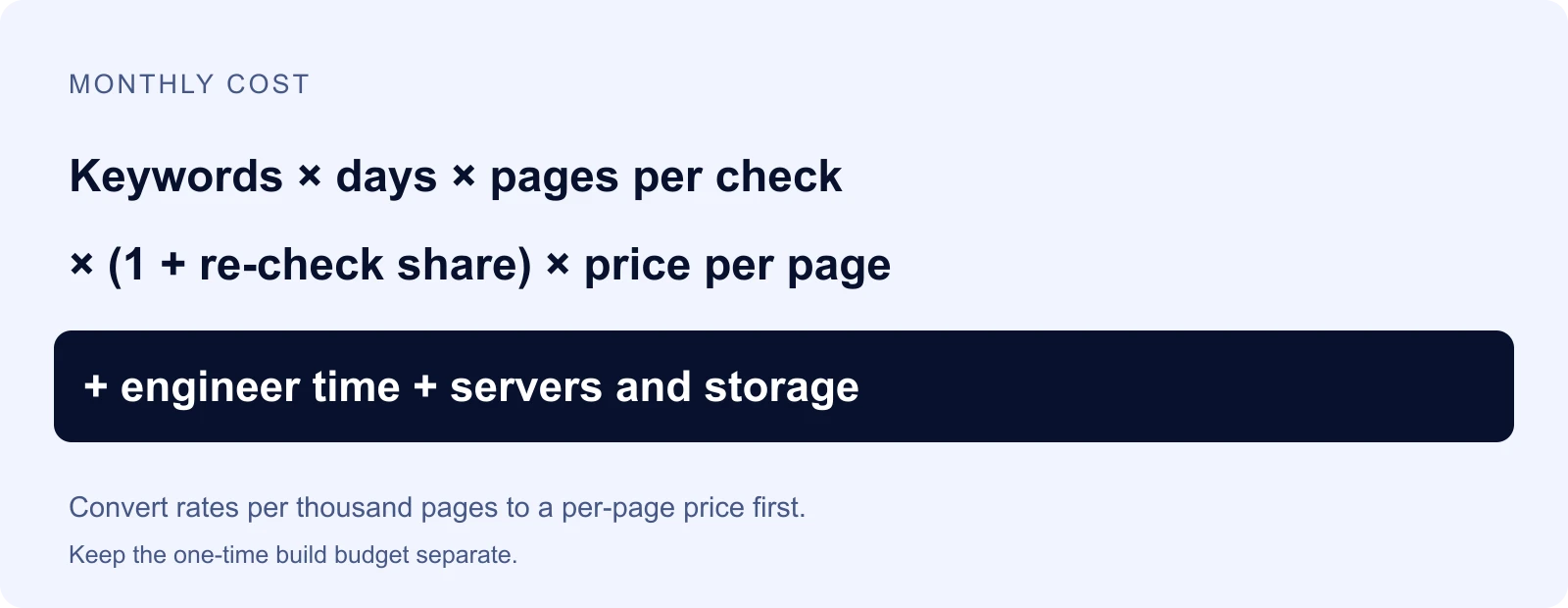
A “keyword” here means one phrase checked on one device in one location. If you track the same phrase on desktop and mobile, count both. If several clients share the same phrase, device, and location, you may be able to use one set of results for all of them.
SERP API pricing and the other inputs
Here are the inputs for our example. All amounts are in USD. API rates come from public list prices of SERP APIs, November 2026, checked on November 19. Build time, maintenance time, and hosting are our estimates.
| Input | Value used | What it means |
|---|---|---|
| Days per month | 30 | One scheduled check each day. |
| Pages per check | Top 50 = 5; Top 100 = 10 | Assumes about ten organic results per page. |
| Price per 1,000 pages | $0.60–$2.50 | List prices at about 100,000–1 million pages a month. The cheapest option uses a queue, so results aren’t immediate. |
| Extra checks | 0% or 20% | Two examples to try. Neither is a measured failure rate. |
| Full-time developer | About $16,200 a month | A US salary benchmark with employer costs added. |
| Ongoing maintenance | 10–25% of a developer’s time | Our estimate for fixes, monitoring, and handling failures. |
| Initial build | 2–3 months of one developer | Our estimate for a basic tracker with scheduling, history, and reports. |
| Servers and storage | $100–$500 a month | Our estimate; keeping more result pages and backups can cost more. |
For the developer cost, we use the BLS median software developer salary: $135,980 a year in May 2025. We divide it by twelve and add employer costs using BLS’s June 2026 compensation figures, where wages make up 70% of private-industry compensation. That gives the rounded monthly figure above. The employer-cost figure covers private industry as a whole; use your actual costs where you have them.
An existing developer still has a cost: time spent repairing the tracker is time unavailable for client work.
What it costs to track 5,000 keywords with an in-house rank tracking tool
Suppose your agency checks the Top 50 for every keyword each day. That uses 750,000 result pages a month before any extra checks.
Here is the monthly budget alongside our API plan for the same keyword count, daily frequency, and Top 50 depth. The low custom-tracker total uses the cheapest end of each estimate; the high total uses the most expensive end.
| Cost | Per month | Developer share of total |
|---|---|---|
| SERP API pages | $450–$1,875 | — |
| Developer time | $1,620–$4,050 | — |
| Servers and storage | $100–$500 | — |
| Custom tracker total | $2,170–$6,425 | 75% at the low end; 63% at the high end |
| Keyword.com API plan | $195 | — |
Our API plan price is billed monthly, checked November 19, 2026. It covers rank checks and history; your dashboard, hosting, and integration work are extra. The subscription is 57% cheaper than even the lowest result-pages estimate, before you count the developer time needed to run a custom tracker.
The initial build adds about $32,000–$49,000 once, based on the build-time estimate above. It is separate from the monthly total.
Checking the Top 100 doubles the results bill to $900–$3,750. Our API plan for the same daily keywords at that depth is $370/month, on the same billing terms and verification date. If you request a fifth more pages for re-checks, add a fifth to the results bill. Developer time and hosting stay as separate costs.
Use your own maintenance estimate: a basic internal chart may need less attention than daily client reporting.
For a ready-made dashboard and client reporting, compare our platform plans. To keep your own dashboard, use the API option below.
How in-house rank tracking costs scale with keyword volume
Here is the same calculation for smaller and larger keyword lists. These totals exclude extra checks and the initial build.
| Daily keywords | Top 50: results | Top 50: total | Top 100: results | Top 100: total |
|---|---|---|---|---|
| 1,000 | $90–$375 | $1,810–$4,925 | $180–$750 | $1,900–$5,300 |
| 10,000 | $900–$3,750 | $2,620–$8,300 | $1,800–$7,500 | $3,520–$12,050 |
| 50,000 | $4,500–$18,750 | $6,220–$23,300 | $9,000–$37,500 | $10,720–$42,050 |
We keep developer time, hosting, and the price per page the same so you can see the effect of adding keywords. At larger volumes, you may negotiate a lower page price or need more maintenance. Get a quote and estimate that work before committing to the larger budgets.
For a smaller list, the developer is most of the cost. As the list grows, result pages take a larger share. Tracking fewer positions or checking less often can reduce that bill, provided the results still meet your clients’ needs.
What SEO agencies need from an in-house rank tracker
The budget covers a basic tracker. Check which agency requirements your developer has included and which add work.
Ranks you can trust. A sudden drop needs checking before you send it to a client. Your system must spot unusual results, run another check, and decide what to show if the answer is still unclear. Our guide to checking rank tracker accuracy covers what to look for. You can also review the method in our published rank tracker accuracy report.
History and proof. When a client asks why they dropped, you need the results behind the recorded rank. Save the page along with its date, device, and location. Stored SERP verification shows how that helps you explain a change. For a fresh check, you can use Spyglass, the free SERP simulator. A fresh result won’t tell you what was on the page last Tuesday.
Client reports. Each client needs to see their own data, with the right branding and access. That may mean white-label reports, Shared projects, scheduled emails, or client logins in your own system. Decide what you need to deliver before building the dashboard. Our guide to reporting keyword rankings can help you define the report.
Mobile, local, and Maps results. A client with several locations may want local rankings for each city, on mobile as well as desktop, and their Google Maps position. Those are separate checks with different settings. Adding them means more than putting another filter on the chart.
Useful alerts. Clients may want to know when a keyword enters or leaves the top ten. You need rules for when to send that email, especially if a check is missing or the result looks suspicious. Otherwise, a temporary data problem becomes a client asking what went wrong.
AI search. A client asking whether ChatGPT mentions their brand needs more than a Google ranking chart. The same applies to citations in Google AI Overviews. AI search visibility adds another set of questions, checks, and reports to the project.
Someone to fix it. Your data stops on a Monday morning, before a client meeting. Who notices? Who repairs it if the developer is away? The Google changes above show why someone needs to own these fixes. Include that responsibility in your agency’s standard operating procedures. Building the tracker also means agreeing who keeps it running.
If client reporting is the main reason for the project, try white-label reports and Shared projects with a real client first. You may find the report you need already exists.
How Keyword.com’s API lowers the cost of a custom rank tracking dashboard
You can keep your Looker Studio report or vibe-coded dashboard and use Keyword.com’s Rank Tracker API to supply the rankings. We handle the scheduled rank checks and history. Your developer builds the reports your team wants.
In the example above, our API subscription is already cheaper than buying the result pages. You also avoid building and maintaining the system that schedules checks, investigates suspicious drops, and stores ranking history.
Your dashboard and API connection still need work. Add that cost to the subscription before comparing it with the full custom-tracker budget. The saving comes from the lower data bill and the ranking system your developer no longer has to maintain.
We also provide an MCP server, included with every plan. It connects your Keyword.com data to AI assistants such as Claude Code, Codex, and Cursor. Ask which keywords dropped this week or how a client’s share of voice changed, and the assistant can fetch the data for you. If that is what you need, you may not need a custom dashboard at all. Follow the MCP setup guide to connect your account without building your own API integration.
Compare our API plans before committing to the full build. Then check the API documentation for the data your reports need.
When building your own rank tracker makes sense
Building is easier to justify when your team already runs data systems. You may have people who maintain scheduled jobs, databases, and monitoring. In that case, estimate the extra work the tracker adds to their existing responsibilities.
It can also make sense if you sell a product that needs raw result pages. A ranking number may not give you enough detail for your analysis. The cost then belongs in the budget for that product, with someone responsible for maintaining it.
Some organizations have legal restrictions on where data can be stored or processed. Those can affect the choice too. Check the whole setup against those requirements, including the API and hosting you plan to use.
Should your agency build or buy a rank tracker?
Compare the full build and running costs with a tracker that covers your client work. Our list of affordable rank trackers and their prices shows what ready-made tools cost. Our API lets you keep your own dashboard and buy the rankings, freeing developer time for work that helps grow the agency. Start a 14-day free trial, no credit card, and test it with a real client report before committing to the build.