Greater Rank Tracking Depth and Consistency: Keyword.com Now Supports Top 50 and Top 100 Rankings
Rank tracking only works when the data is clear, consistent, and easy to explain.
That is why we are updating how ranking depth works in Keyword.com. Instead of relying on Hybrid Tracking and OTR (outside tracked range), Keyword.com now supports Top 50 rank tracking by default, with the option to upgrade to full Top 100 tracking when deeper visibility is needed.
This update provides teams with cleaner reports, fewer ambiguous ranking statuses, and greater control over how deeply they track Google results. In this article, we’ll explain why we’re making this change, what happened after Google removed the &num=100 parameter, how Hybrid Tracking helped in the short term, and why Top 50 and Top 100 tracking give SEO teams a clearer way forward.
The &num=100 Change and How Keyword.com Handled the Shift
Last year, Google removed support for the &num=100 parameter, which had a major impact on the rank tracking industry.
For years, many SEO tools, including Keyword.com, relied on &num=100 because it allowed them to retrieve up to 100 Google results per request. It was efficient, affordable, and relatively easy to manage.
Once that method disappeared, rank trackers had to change how they collected deeper ranking data. To get the same Top 100 results, tools now had to rely on paginated scraping, which meant collecting results page by page rather than all at once. That created a difficult trade-off: keep tracking deeper rankings and absorb higher scraping costs, or reduce ranking depth to keep costs under control.
Different rank monitoring tools responded in different ways.
- Some reduced their tracking depth to Top 20, Top 30, or Top 50 results.
- Others continued offering Top 100 rankings while absorbing the added cost or increasing prices.
- Some introduced smarter scraping controls, such as stopping once the tracked website was found instead of always pulling the full Top 100.
At Keyword.com, our first response was Hybrid Tracking. The goal was simple: continue giving users Top 100 ranking visibility without immediately passing higher scraping costs on to customers.
Hybrid Tracking combined two types of ranking checks: a Top 100 scan and a more frequent Top 20 scan. The Top 100 scan gave users deeper ranking visibility, while the Top 20 scan helped keep day-to-day tracking costs manageable.
When a keyword was found in the Top 20 scan, we showed the exact confirmed position. When it was not found, we used OTR (Outside Tracked Range) to indicate that the website may still be ranking lower in the results, but had not been confirmed in that particular scrape.
Hybrid Tracking helped us solve the immediate problem. It allowed us to keep offering Top 100 visibility at a time when collecting deeper results had become much more expensive. But over time, it also introduced a new issue: ranking data became harder to interpret.
Why We’re Replacing Hybrid Tracking With Top 50 and Top 100
Hybrid Tracking was the right solution at the time. It allowed us to keep offering Top 100 visibility without immediately passing on the higher scraping costs to customers, and it was well received when we rolled it out.
But over time, we found that OTR made ranking data harder to interpret. When a keyword was marked as OTR, it did not always mean the website had fallen out of the Top 100.
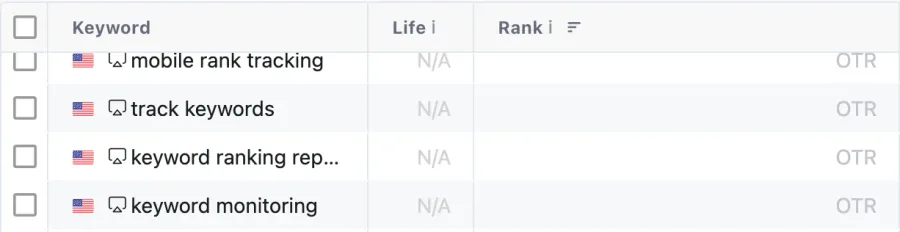
For example, a keyword might rank at position 47 one day, then show as OTR the next. That did not always mean it dropped out of the Top 100 — it may have simply been outside the scan depth for that check.
For agencies, this was especially frustrating. When sharing reports with clients, OTR added an extra layer of explanation. Instead of the data being immediately clear, teams had to clarify what OTR meant, whether rankings had actually dropped, and why some keywords did not show exact positions.
Introducing Top 50 by Default, With Top 100 When You Need It
We’re moving away from Hybrid Tracking and introducing a simpler, more consistent setup: Top 50 rank tracking by default, with the option to upgrade to full Top 100 tracking.
For most SEOs, the Top 50 provides the ranking depth they need for day-to-day tracking, reporting, and client conversations. It also removes OTR entirely, making rankings easier to understand and reports cleaner.
What Does This Mean for You?
Existing Keyword.com users can switch to Top 50 tracking at no extra cost within the app. New users will start with the Top 50 tracking by default. And for most teams that still need full Top 100 visibility, Top 100 tracking will be available as an upgrade directly inside their account.
Evolving Rank Tracking as Search Changes
At Keyword.com, we remain committed to delivering accurate, reliable rank tracking that SEO teams can trust.
The shift away from &num=100 changed how the industry collects ranking data, and we have continued to evolve our approach in response. Moving to Top 50 tracking by default, with Top 100 available when deeper visibility is needed, is the next step in that evolution.
It gives teams clearer reporting, more consistent ranking data, and the flexibility to choose the tracking depth that best fits their workflow. As search continues to change, we’ll keep improving Keyword.com to help customers track rankings with confidence and turn that data into decisions.
Please reach out to our team if you have any questions about this change.