The 8 Best Ahrefs API Alternatives for SEO Agencies and Teams
SEO agencies and teams looking to switch from the Ahrefs API to a more budget-friendly alternative usually do so for three reasons: the cost no longer makes sense at their scale, API limits are getting in the way of their workflows, or they are paying for a much broader dataset than they need.
That does not mean the cheapest SEO API is automatically the best Ahrefs replacement. Lower API pricing often comes with tradeoffs: narrower data coverage, less historical data, slower refresh rates, stricter request limits, weaker documentation, or more engineering work to get the data into a usable format.
The question is which of those tradeoffs will actually affect your workflow.
In this guide, we compare eight Ahrefs API alternatives based on their pricing model, data coverage, limits, documentation, and support for automated reporting, rank tracking, and AI-powered SEO workflows. The goal is to help you reduce costs without giving up the parts of the API your team relies on.
TL;DR: The Best Ahrefs API Alternatives Compared
| Tool | Best For | API Model | Starting Cost |
|---|---|---|---|
| Keyword.com | Rank tracking and client reporting | Managed rank-tracking projects, read/write | $48/mo (Top 50, annual) |
| DataForSEO | API-first products, on-demand data | On-demand sync/async collection | $0.0006 per SERP request, $50 minimum top-up |
| SE Ranking | Agencies managing recurring client workflows | Managed project API + on-demand database API | €45 for 250,000 credits |
| Semrush | Existing Semrush users needing broad data | SEO database API + managed project APIs | Business subscription + separately purchased units |
| Majestic | Backlink-focused audits and prospecting | Backlink database API (Fresh/Historic) | €379.99/mo |
| Otterly.ai | AI visibility data for client dashboards | Managed daily prompt tracking, read/write | $189/mo (100 prompts) |
| Serpstat | Replacing several Ahrefs datasets at once | SEO database API + project endpoints + live SERPs | $129/mo (Team plan) |
| Bright Data | Custom rank trackers needing live SERP data | On-demand SERP collection, sync/async | 5,000 free requests/mo, then $1.50/1,000 requests |
What Does the Ahrefs API Provide?
The Ahrefs API gives you programmatic access to much of the data available across the Ahrefs platform. Rather than exporting reports manually, you can pull the data directly into client dashboards, internal tools, spreadsheets, data warehouses, or automated reporting workflows.
Through API v3, you can access:
- Backlink data: backlinks, referring domains, anchor text, broken links, Domain Rating, URL Rating, and historical link growth.
- Organic search data: ranking keywords, estimated traffic, top-performing pages, competitors, paid search data, and performance by country.
- Keyword research data: search volume, keyword difficulty, traffic potential, historical volume, country-level metrics, and keyword ideas.
- SERP data: the top 100 Google results for a keyword, including ranking URLs and associated SEO metrics.
- Rank Tracker data: tracked keyword positions, SERP history, competitor performance, and project-level reporting data.
- Site Audit data: site health scores, technical SEO issues, and information from crawled pages.
- Batch analysis: domain and URL metrics for up to 100 targets in a single request.
- AI visibility data: brand mentions, cited URLs, prompts, competitors, and historical performance across supported AI platforms through Brand Radar.
- Web and social data: analytics from Ahrefs Web Analytics and connected social media accounts.
The API also includes management endpoints for creating and updating Rank Tracker projects and Keywords Explorer lists. This makes it possible to build workflows that do more than retrieve data — for example, automatically adding new client keywords to tracking projects or updating projects from another system.
API access is bundled into Ahrefs’ regular subscription plans rather than sold separately. It’s included starting with the Lite plan at $129 per month, through Standard ($249) and Advanced ($449), up to Enterprise at $1,499 per month for uncapped access. Lower tiers cap the credits available per user, so the plan you’re on affects how much API usage you can actually run before needing to upgrade.
Most requests consume API units based on the number of rows returned and the fields requested, with a minimum charge of 50 units for paid requests. Ahrefs also applies a default limit of 60 requests per minute. Those rules matter when you are pulling large datasets or running reports across many clients, because the cost of the API depends not only on how often you make a request, but also on how much data each request returns.
The Best Ahrefs API Alternatives for SEO Workflows
Some of the alternatives below offer a broad enough dataset to replace the Ahrefs API across multiple workflows, while others are stronger for specific use cases such as rank tracking, backlink analysis, SERP data, or AI visibility. We compare what each API covers, how its pricing scales, and where you may need to accept tradeoffs.
For a broader primer before narrowing down, see our guide to the best SEO APIs for marketers.
1. Keyword.com: Rank Tracker API for SEO Agencies
Built for: Agencies that need maintained ranking history for client dashboards, automated reports, and internal tools
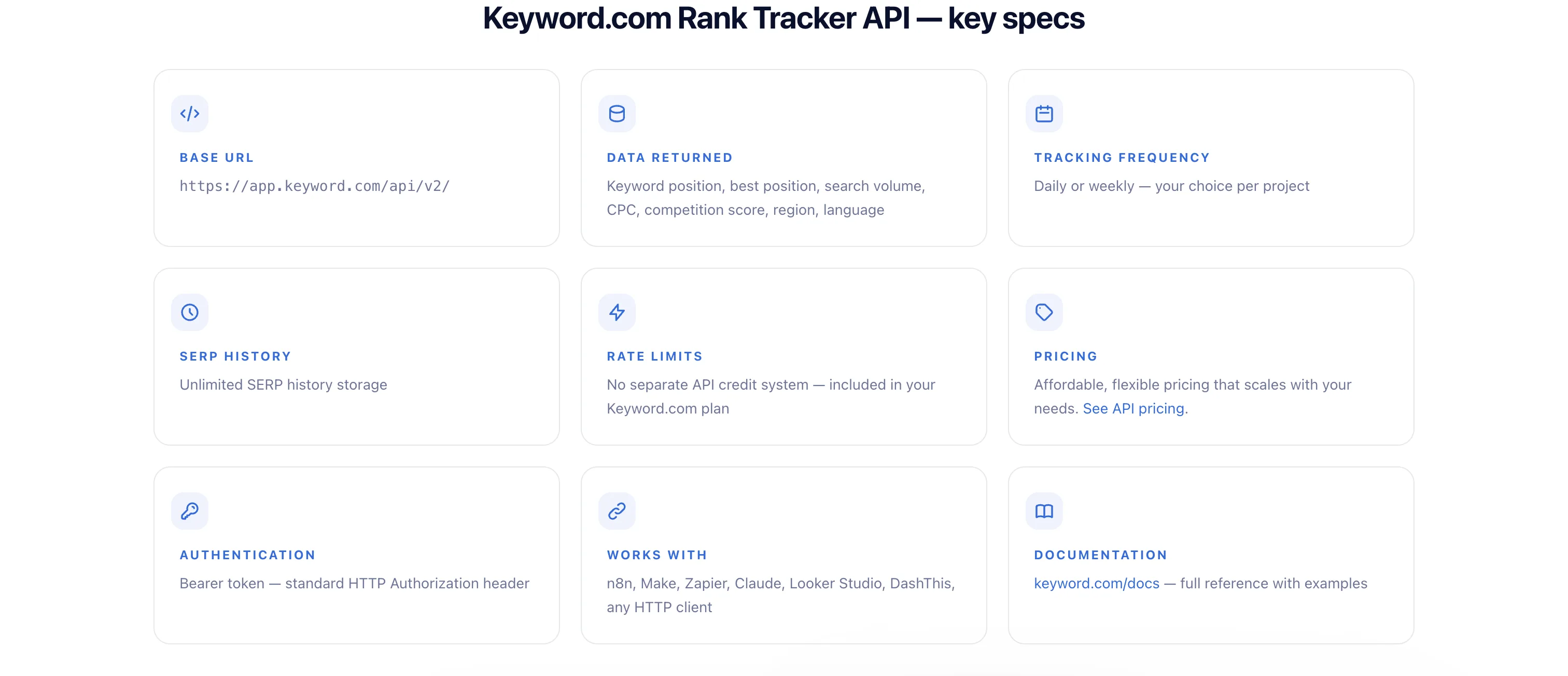
API model: Managed rank-tracking projects with read and write APIs Core coverage: Current and historical rankings, ranking URLs, SERP features, Share of Voice, keyword metrics, project management, and AI visibility
Starting cost: API-only plans currently start at $48 per month for Top 50 tracking or $65 per month for Top 100 tracking when billed annually; pricing varies by keyword volume and update frequency.
Main constraint: It does not replace Ahrefs’ backlink index, Site Explorer, or broader keyword-research database
Keyword.com’s Rank Tracker API provides current and historical positions, ranking URLs, position changes, search volume, intent, CPC, SERP features, location and device data, and Share of Voice. Its write endpoints let you create and manage projects, add or remove keywords, and trigger on-demand ranking updates from your own system. It also has a separate AI Visibility API that provides aggregated brand visibility, sentiment, competitor benchmarks, and engine- or topic-level trends, although it does not return the full text of individual AI responses.
The main difference is how usage is priced. Instead of charging API units based on the fields and rows returned, Keyword.com prices its API-only plans by keyword volume, update frequency, and ranking depth. Plans currently start at $48 per month for Top 50 tracking or $65 for Top 100, with no per-call charges or overage fees. Standard request limits still apply, including 60 requests per minute for most endpoints.
Keyword.com handles the scheduled ranking checks and retains the resulting history. Your team still needs to build the dashboard, reporting layer, data warehouse, or internal tool that consumes the API, but it does not need to schedule individual SERP requests or maintain its own ranking archive. See real rank-tracking API workflows for how agencies plug this into client reporting, or how agencies use Keyword.com’s rank tracker day to day.
2. DataForSEO: Best for API-First Products and On-Demand SEO Data
Built for: Custom products and technical teams that want broad SEO data without a platform subscription
API model: On-demand synchronous and asynchronous collection
Core coverage: SERPs, keywords, domains, backlinks, site crawling, business data, content, and AI search
Starting cost: Usage-based pricing, with Standard Google SERP requests starting at $0.0006 for the first 10 results and a $50 minimum account top-up.
Main constraint: DataForSEO supplies the data, but your team must build and maintain the tracking workflow
DataForSEO exposes separate APIs for SERPs, keyword and competitor research, backlinks, site crawling, business data, content analysis, and AI search. For rank-tracking use cases, you specify the keyword, location, language, and device and receive the corresponding SERP. You then identify the ranking domain or URL and store the result in your own system.
Pricing varies by product and delivery method. Standard Google SERP requests start at $0.0006, while other endpoints charge per task, result, or returned row. The cheaper Standard method is asynchronous: you submit a task and retrieve it later or receive the result through a callback. Live requests return synchronously but cost more. There is no recurring subscription, although the minimum account top-up is $50 and unused funds do not expire.
DataForSEO handles collection and access to the underlying data. Your team still owns scheduling, task retrieval, retries, ranking-URL matching, historical storage, position-change calculations, alerts, and reporting. It is economical when that control is valuable and you already have the engineering infrastructure. It is less suitable when you want a provider to maintain the keyword set and ranking history for you.
3. SE Ranking: Broad SEO Data and Project Automation APIs
Built for: Agencies that want to manage recurring client workflows inside an SEO platform while also pulling research data into their own tools
API model: Managed project API plus an on-demand database API
Core coverage: Rank tracking, keyword and competitor research, backlinks, SERP data, website audits, AI visibility, and agency account management
Starting cost: Wallet credits start at €45 for 250,000 credits. The API add-on starts at €39 per month and the standalone API at €155 per month, both billed annually. Pricing is localized and credit allowances vary by tier.
Main constraint: Data API requests consume credits, while Project API workflows are also governed by the project, keyword, audit, and user limits of the underlying subscription.
SE Ranking splits its functionality between two APIs.
- The Data API queries SE Ranking’s existing databases for research and analysis.
- The Project API manages workflows inside an SE Ranking account, including creating projects, adding keywords, retrieving rankings, running audits, monitoring backlinks, and managing agency subaccounts.
For example, you can use the Data API to enrich an internal tool with keyword, competitor, or backlink data, while using the Project API to automate the recurring work attached to each client account. Both use the same API key, but they are billed differently: Data API requests consume credits, while Project API actions count against the project, keyword, and audit limits in your subscription.
The billing model depends on which API you use. Successful Data API requests consume credits, with costs charged either at a fixed rate per request or according to the number of records returned. Failed requests are not charged. Project API actions do not use the API credit balance, but they consume the limits included in your SE Ranking subscription. For example, adding tracked keywords uses your keyword allowance, while launching an audit uses your audit-page quota.
For occasional or unpredictable use, the Wallet starts at €45 for 250,000 non-expiring credits. Existing SE Ranking customers can add API access from €39 per month when billed annually, while the standalone Data API starts at €155 per month on annual billing and does not require a subscription to the main platform. A 14-day trial includes 100,000 credits and access to all API endpoint groups.
The standard rate limit is five requests per second for the Project API and ten requests per second for the Data API. SE Ranking maintains the projects, scheduled ranking checks, audit crawls, backlink monitoring, and associated history inside the platform.
4. Semrush: A Broad Ahrefs API Alternative for Existing Semrush Users
Built for: Teams already using Semrush for research, rank tracking, and site audits that want to send the same data into internal tools or reporting systems
API model: SEO database API plus managed project APIs
Core coverage: Domain and keyword research, organic and paid search, backlinks, Position Tracking, Site Audit, and project management
Starting cost: A Business subscription plus separately purchased API units; upgrading to Business does not include an API-unit allowance
Main constraint: The subscription and API units create a high entry cost if you only need one dataset
Semrush is the closest alternative to Ahrefs in terms of dataset breadth. Its APIs cover domain and keyword research, organic and paid search data, backlinks, Position Tracking, Site Audit, local SEO, and selected AI search data. You can also create and manage projects programmatically, which makes it suitable for automated reporting and internal SEO platforms rather than one-off data lookups.
The main drawback is the cost of entry. Standard API access requires a Business subscription, and upgrading does not include an API allowance by default. You must purchase API units separately. This makes Semrush difficult to justify as a budget alternative if you are subscribing primarily for API access, although it may be more economical for teams already paying for the Business plan.
Usage is charged either per request or per line returned, depending on the report. Historical data typically consumes more units than current data. Semrush’s own example estimates that retrieving 500 current and historical ranking keywords for 50 domains would use 1.5 million units, so limiting returned rows and separating essential fields from optional analysis is important at agency scale.
There are also implementation constraints to account for. Semrush permits up to 10 requests per second and 10 concurrent requests per account. API data cannot be cached for longer than one month without written permission, which may affect how you design a data warehouse or maintain historical client reports.
Semrush is currently moving several API products to v4, with older Projects, Backlinks, and Keyword methods being deprecated. Check the current version and authentication requirements for every endpoint before estimating the migration work.
For a closer look at how the two compare on rank tracking specifically, see Ahrefs vs. Semrush.
5. Majestic: A Specialist Backlink API
Built for: Teams building backlink audits, link-prospecting tools, digital PR workflows, or internal applications where link intelligence is the primary dataset
API model: Backlink database API with separate Fresh and Historic indexes
Core coverage: Backlinks, referring domains, anchor text, new and lost links, top-linked pages, link history, link context, and proprietary Flow Metrics
Starting cost: Direct Full API access starts at €379.99 per month on Majestic’s current EU pricing page; pricing is localized by market.
Main constraint: Majestic only replaces the backlink-analysis portion of Ahrefs, and its three-part resource model takes more work to forecast
Majestic is worth considering when backlinks are the main reason you use the Ahrefs API. It is not a broad replacement for Ahrefs’ keyword research, rank tracking, site auditing, and AI visibility tools. Its API is built primarily around link intelligence.
You can retrieve individual backlinks, referring domains, anchor-text distributions, top-linked pages, backlink history, and new or lost links. The API also exposes Majestic’s proprietary Trust Flow, Citation Flow, and Topical Trust Flow metrics, alongside link attributes such as first-seen dates, redirect status, nofollow markers, image links, and link context. Data can be queried from its frequently updated Fresh Index or its longer-term Historic Index.
Direct API access starts with Majestic’s API plan at €379.99 per month. The entry API plan includes five users, 100 million analysis units, 20 million retrieval units, and 500,000 index-item units. Lite and Pro users can connect their accounts to third-party OpenApps, but they do not receive direct API access.
The resource model takes some work to price accurately. Different commands consume separate pools of analysis, retrieval, and index-item units, and operations such as deeper filtering or sorting can use additional resources. Majestic provides a development endpoint with a limited test dataset, so you can build and validate the integration before running requests against the live index.
6. Otterly.ai: A Budget-Friendly API for AI Visibility Data
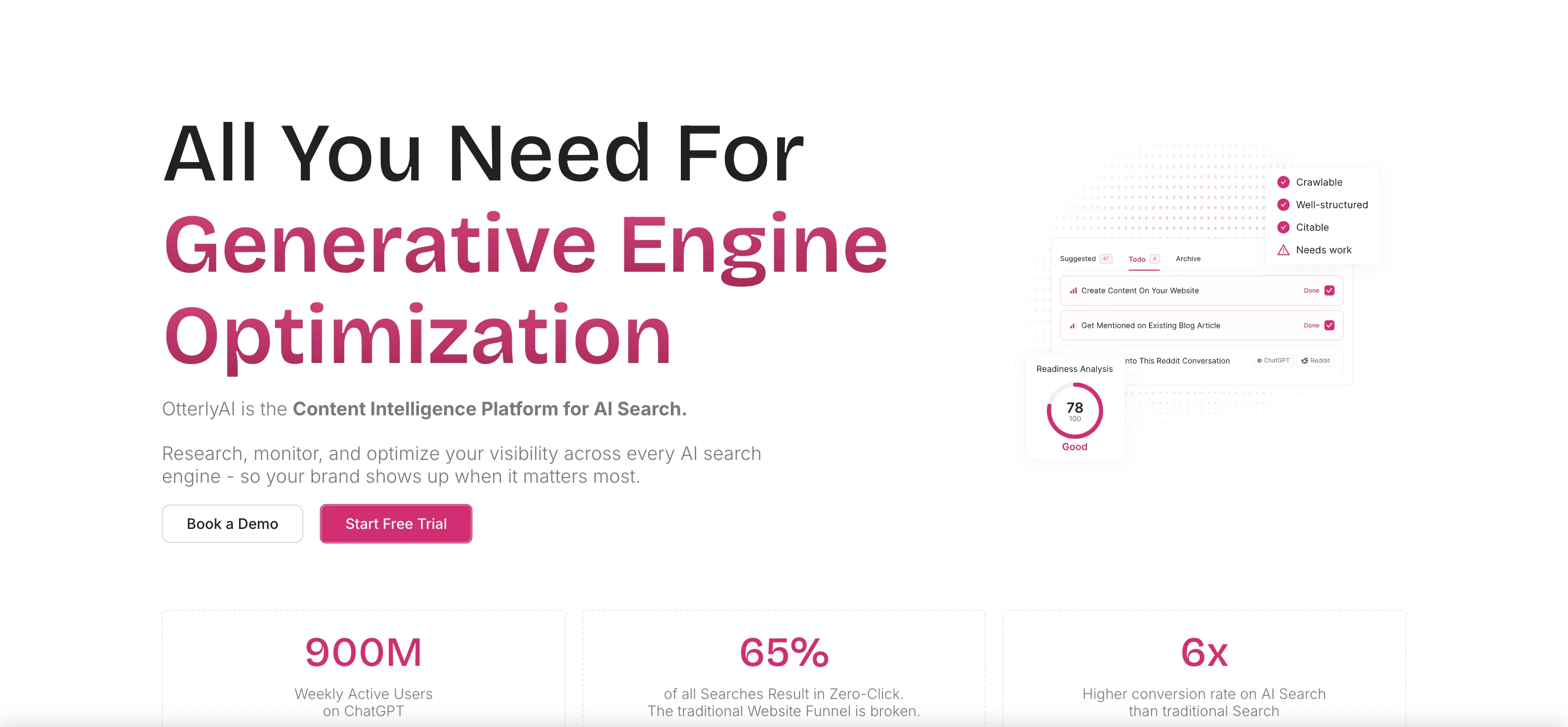
Built for: Agencies and marketing teams that need AI visibility data for client dashboards, automated reports, and internal tools
API model: Managed daily prompt tracking with read and write APIs
Core coverage: Brand reports, prompts, AI responses, mentions, citations, share of voice, sentiment, competitors, recommendations, and GEO audits
Starting cost: The Standard plan starts at $189 per month for 100 monitored prompts; API limits are plan-specific and should be confirmed in the account billing screen.
Main constraint: Prompt volume, API allowances, and access to some AI engines depend on the selected plan and add-ons.
OtterlyAI is a specialist alternative for teams that need to pull AI search visibility data into client dashboards, data warehouses, or automated reports. It does not replace Ahrefs’ backlink, keyword research, or conventional rank-tracking APIs. Instead, it covers the newer reporting workflows built around brand mentions and citations in AI-generated answers.
The API provides access to brand coverage, share of voice, sentiment, domain citations, prompt-level results, AI responses, competitors, and recommendations. It supports ChatGPT, Google AI Overviews, Google AI Mode, Perplexity, Gemini, Claude, and Microsoft Copilot.
OtterlyAI also includes write endpoints. You can create and remove monitored prompts, manage tags, and run GEO audits such as crawlability checks, content checks, and query fan-out analysis. This makes it possible to manage parts of the monitoring setup from your own system rather than using the API only as a reporting export.
API access starts with the Standard plan, currently priced at $189 per month for 100 monitored prompts and 2,000 API requests. The Premium plan costs $489 per month, includes 400 prompts, and increases the allowance to 5,000 requests. You cannot currently purchase additional API requests separately, so teams that exceed the allowance must upgrade or request a custom plan.
One practical advantage is that OtterlyAI lets trial users test the API before subscribing. The seven-day trial currently includes 50 prompts and 1,000 API calls, which should be enough to validate the endpoints against a real reporting workflow.
If AI visibility is the main dataset you need, see our full breakdown of Otterly.ai alternatives for AI rank tracking.
7. Serpstat: Broad SEO Data Without Ahrefs-Level Pricing
Built for: Teams that want to replace several Ahrefs datasets without moving to another premium-priced platform
API model: SEO database API, managed project endpoints, and live SERP collection
Core coverage: Keywords, domains, competitors, backlinks, rank tracking, site audits, search volume, and live SERPs
Starting cost: $129 per month for the Team plan, which includes API access; available API credits and module limits depend on the current plan configuration.
Main constraint: API queries, rank tracking, backlinks, and audits use separate credit or project allowances
Serpstat is a strong option when you need to replace several Ahrefs workflows without moving to another premium-priced platform. The main tradeoff is its credit structure: search analysis, backlinks, audits, rank tracking, and API usage have separate allowances, so you need to model both API consumption and the platform limits attached to the projects you manage.
The API includes both database queries and project-based workflows. You can retrieve existing search and backlink data, but you can also create rank-tracking projects, configure their settings, and pull current or historical positions programmatically.
Serpstat’s SERP Crawling API can also collect Google AI Overview responses and cited sources. AI Overview collection is an optional paid parameter rather than a standard inclusion in every desktop SERP request. This is not the same as a dedicated AI visibility platform that tracks brands across ChatGPT, Gemini, Perplexity, and other assistants.
API access is available on the Team and Agency plans. The Team plan currently starts at $129 per month, and Serpstat offers a seven-day Team trial that includes API access. For teams that only need high-volume data delivery, it also offers custom API-only plans and bulk datasets.
Most API usage is measured by the results returned: one result row generally consumes one API credit, while some summary reports have a fixed charge. Credits included in your subscription reset each billing cycle, while separately purchased top-ups remain available as long as the subscription stays active.
8. Bright Data: Low-Cost SERP Data for Custom SEO Tools
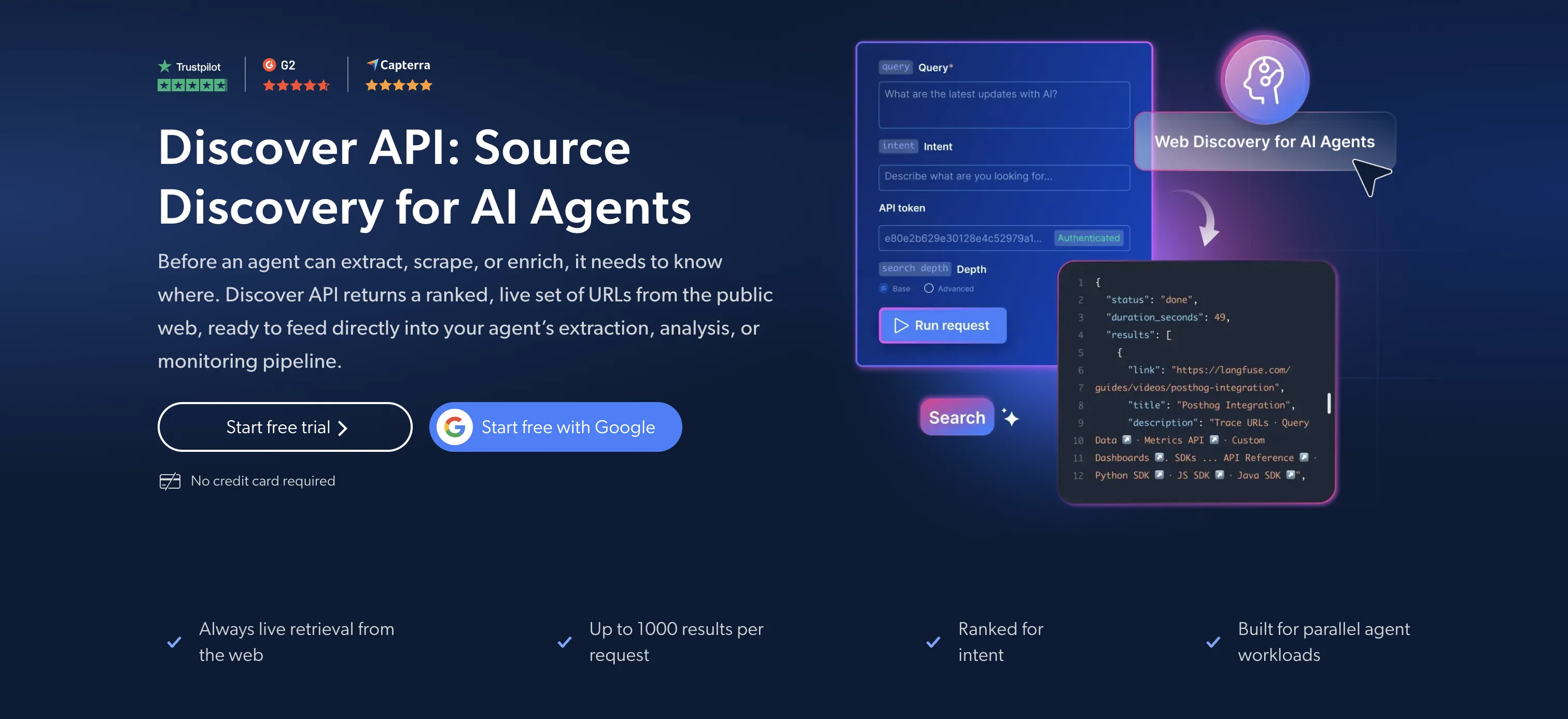
Built for: Technical teams building custom rank trackers, local search-monitoring systems, or applications that need live search results at scale
API model: On-demand SERP collection with synchronous and asynchronous delivery
Core coverage: Organic results, ads, shopping results, images, maps, news, and other SERP features across Google and other major search engines
Starting cost: 5,000 free requests per month, followed by pay-as-you-go pricing of $1.50 per 1,000 successful requests
Main constraint: Bright Data returns raw SERP data but does not maintain tracked keyword projects or ranking history
Bright Data is a useful Ahrefs API alternative when your workflow depends on collecting live search results rather than querying an existing SEO database. Its SERP API can return up to 100 Google results in one request, with controls for location, language, device, pagination, and search type. It also supports other search engines, including Google, Bing, DuckDuckGo, and Yandex.
The API returns parsed JSON, HTML, or Markdown and handles the infrastructure normally required to collect search results at scale, including proxies, CAPTCHA solving, browser rendering, retries, and IP rotation. It supports both synchronous and asynchronous collection, with unlimited concurrent requests.
Pricing is straightforward. Bright Data currently includes 5,000 free requests per month, after which pay-as-you-go usage starts at $1.50 per 1,000 successful requests. Failed requests are not charged, and retrieving the result of an asynchronous request does not consume an additional paid request.
The tradeoff is that Bright Data provides the SERP results, not the finished rank-tracking workflow. Your team must schedule collections, identify ranking URLs, store historical results, calculate changes, and build the reporting layer. It also does not replace Ahrefs’ backlink index, keyword database, or proprietary SEO metrics.
If you’re weighing these two directly, see our Bright Data vs. DataForSEO comparison.
How to Choose the Best Ahrefs API Alternative for Your SEO Workflow
Start by documenting what your Ahrefs integration does today. List the endpoints it calls, the fields it uses, the number of records it processes, how frequently each job runs, and where the resulting data is sent.
That is the specification the replacement needs to meet. Without it, you are comparing API feature pages rather than evaluating whether another provider can run your workflow.
1. Check for Field-Level Coverage
Do not stop at broad categories such as backlinks, keyword data, or rank tracking. Compare the actual fields your reports, dashboards, and scoring models use.
For example, if an internal prospecting tool relies on referring-domain counts, estimated organic traffic, anchor text, first-seen dates, and “dofollow” status, an API that simply advertises “backlink data” may not be enough.
You should also identify any provider-specific metrics built into your reports or internal models. Ahrefs’ Domain Rating and URL Rating do not have direct equivalents elsewhere. More general metrics such as traffic estimates and keyword difficulty may be available from other APIs, but the underlying datasets and calculation methods will differ. Switching providers may therefore affect historical comparisons, filters, thresholds, and scoring models even when the field names look similar.
2. Price the Queries You Will Actually Run
API pricing is rarely as simple as comparing the number of included credits. Ahrefs calculates the cost of many requests using the number of returned rows and the fields used in the request.
The minimum charge is 50 units, while some fields increase the per-row cost. Cached responses don’t consume units. Rank Tracker, Management, and some other endpoints are free. Its documentation gives an example in which a 500-row backlink request costs 6,000 units because one of the selected fields has a higher unit cost.
Other providers may charge per search, keyword, task, returned result, endpoint, or processing priority. Build a cost model using a normal reporting cycle from your own system. Include pagination, competitor requests, locations, devices, historical queries, retries, and any additional calls needed to retrieve asynchronous results.
A worked example, using the same footprint across providers: Semrush’s own documentation estimates that pulling 500 current and historical ranking keywords for 50 domains costs 1.5 million API units — and that’s before pulling a single backlink, Site Audit result, or subsequent day’s refresh for those same domains. Run that identical 500-keyword, 50-domain footprint through Keyword.com’s Rank Tracker API instead, and it falls under a single flat tier — $48 or $65 a month for the whole tracked set, depending on tracking depth — because pricing is set by keyword volume rather than metered per pull. The two numbers aren’t measuring the same unit, which is exactly the point: a “cheaper” per-unit rate on paper can still cost more in practice once your actual reporting cadence is priced against it.
3. Understand How Requests are Processed
Two APIs can provide similar data while requiring very different implementations.
DataForSEO’s SERP API, for example, offers a Live method that returns data synchronously and a cheaper Standard method that requires you to submit tasks and retrieve them later. It also supports pingbacks and postbacks, allows up to 100 tasks in a POST request, and documents a limit of 2,000 POST and GET calls per minute.
That may work well for a scheduled overnight rank-tracking job. It may be a poor fit for a user-facing tool that needs an immediate response.
Check:
- Whether results are synchronous or asynchronous
- How many keywords or domains can be batched
- How pagination works
- Whether callbacks or webhooks are available
- How long completed results remain available
- How failed and partial jobs are handled
- Whether retrieving a completed task creates another charge
If you’re also weighing AI-agent access alongside a traditional API, see MCP vs. API for SEO automation.
4. Check Whether You Can Manage the Workflow Through the API
Some integrations only retrieve data. Others need to create projects, add keywords, change locations, trigger audits, manage tags, or remove clients without someone logging into the platform. If your workflow requires write access, an API that only exposes reporting endpoints is not a complete replacement, regardless of how inexpensive its data is.
MGID’s implementation, for example, creates an SE Ranking project through the API, launches a website audit, waits for completion, and then retrieves the issues for display in its own product. The company reports running around 300 audits per month through this workflow.
5. Account for Migration and Maintenance
Inspect the changelog, versioning policy, authentication model, key-expiration rules, SDK maintenance, error documentation, and deprecation process.
This is not theoretical. Ahrefs discontinued API v2 access on November 1, 2025. Integrations had to move to v3 endpoints, implement a new OAuth flow in relevant applications, and account for fields that did not map directly between versions.
You cannot eliminate this risk, but you can assess how much warning the provider gives, whether versions can run in parallel, and how much of your integration is tightly coupled to its response schema.
When to Switch from Ahrefs to Another SEO API Provider
Do not switch providers because another API looks cheaper on paper. Switch when your current integration is no longer the most efficient way to produce the output your team or clients need.
Consider switching if:
- You are using Ahrefs as an expensive data source for one narrow workflow. If the integration only powers rank tracking, backlink checks, SERP collection, or AI visibility reporting, a specialist API may provide the required data with a pricing model that scales more predictably.
- The unit model is affecting the quality of the workflow. You are limiting returned rows, removing useful fields, reducing refresh frequency, or splitting jobs purely to control API consumption.
- You are paying twice for the same outcome. This often happens when a team pays for Ahrefs API access but still uses a separate rank tracker, reporting platform, or AI visibility tool to complete the workflow.
Stay with Ahrefs if:
- Your integration genuinely uses the breadth of the dataset. Ahrefs remains difficult to replace efficiently when the same system depends on backlinks, keyword research, competitor data, historical metrics, and rank tracking.
- Your team also relies heavily on the Ahrefs interface. API economics should not be evaluated in isolation if the subscription also supports research, audits, prospecting, and day-to-day analysis across the team.
- Replacing Ahrefs would require several vendors. Combining separate providers for backlinks, rankings, SERPs, audits, and AI visibility can lower data costs while increasing operational complexity.
If rank tracking and client reporting are the main reasons you use the Ahrefs API, Keyword.com is worth evaluating before you commit to a broader replacement.
Our API is built specifically for pulling current and historical ranking data into dashboards, reports, and internal tools, with pricing based on tracked keyword volume rather than API calls. You can also add AI visibility data to the same reporting workflow, making it a more focused option for agencies that do not need to replace Ahrefs’ entire SEO dataset.
Explore the Keyword.com Rank Tracker API to see how it would fit your workflow.